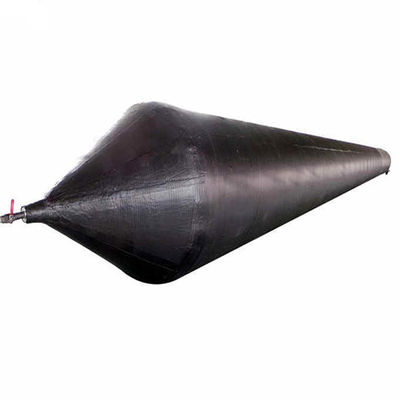
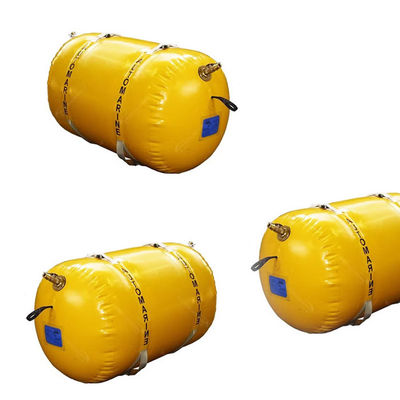
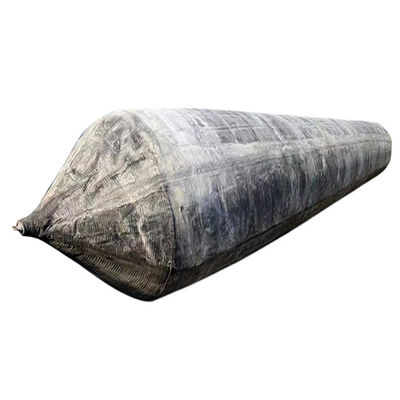
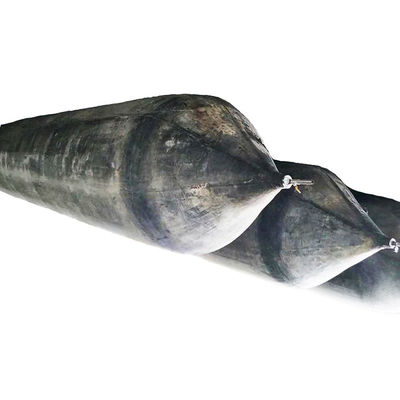
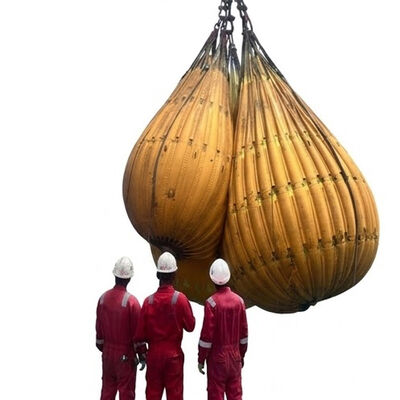
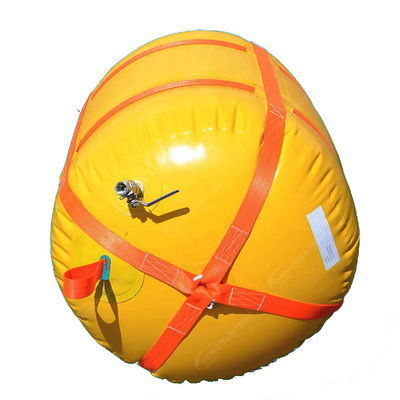
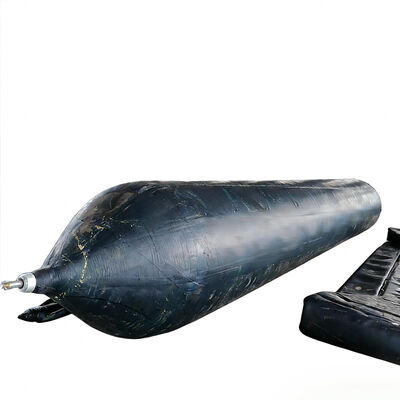
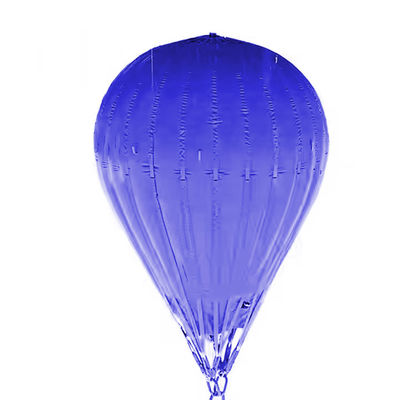
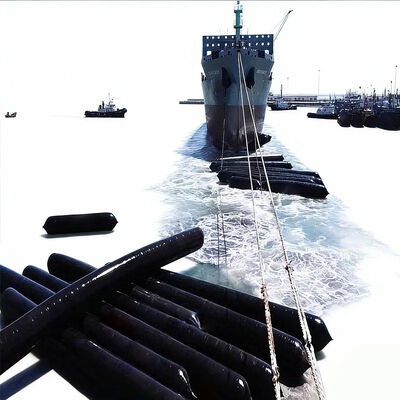
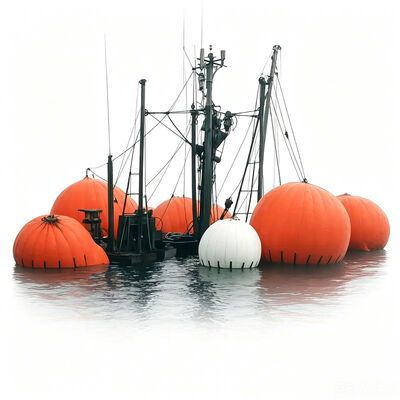
Parachute Type Marine Salvage Airbags for naval and emergency recovery operations are engineered buoyancy systems designed for rapid deployment underwater lifting, defense-related recovery missions, and time-sensitive marine incident response.
The system is constructed from high-tensile industrial polyester fabric combined with a reinforced marine-grade PVC elastomer coating, forming a structural composite designed for impact resistance, seawater immersion stability, and cyclic pressure loading under operational stress conditions.
The operating principle is based on compressed air displacement in submerged environments, generating controlled buoyancy for lifting and recovery of underwater objects. The parachute-type open-bottom configuration functions as an automatic hydrostatic pressure compensation system, enabling continuous adjustment of internal air volume during ascent.
From an engineering perspective, the system is optimized for rapid operational readiness, structural reliability under dynamic loading, and stability during irregular deployment conditions. Reinforced load paths ensure uniform force distribution during lifting of submerged objects with uncertain weight geometry or damage-induced imbalance.
A naval engineering unit conducted an emergency recovery operation involving a partially submerged ship that had suffered structural damage following a collision during harbor maneuvering exercises. The vessel settled at an irregular angle at a depth of approximately 15 meters within a restricted naval zone.
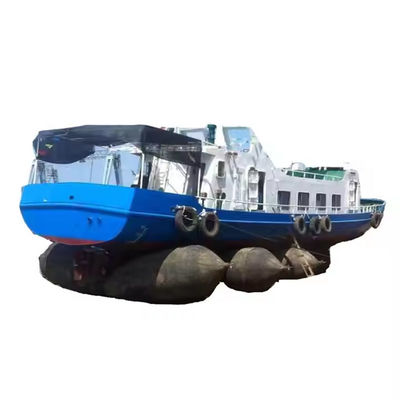
The engineering team implemented a rapid deployment strategy using Parachute Type Marine Salvage Airbags as the primary buoyancy lifting system. Multiple airbags were deployed and attached to structurally stable sections of the hull using reinforced rigging assemblies.
Sequential inflation was performed using portable compressed air systems. The open-bottom pressure compensation mechanism ensured stable buoyancy behavior during ascent, preventing sudden lifting shocks that could further damage the compromised hull structure.
The vessel was successfully refloated within the designated emergency response timeframe and transferred to a secure inspection zone for structural evaluation.
| Product Name | Marine Salvage Airbags |
| Keywords | Boat Lifting Airbag |
| Material | 100% High Performance PVC Coated Polyester Fabric |
| Physical Property | 10,000 N/5cm |
| Nett Buoyancy | 1-200 Tons, or As Request |
| Dimensions | Diameter 0.5m - 3.5m, Length 3.0m - 28.0m, or As Request |
| Type | Enclosed, Open Bottom |
| Shape | Parachute |
| Inflation Tube | 30m, Free of Charge |
| Technology | High Pressure, Overall Winding, Explosion-proof |
| Metal Parts | Q355 / SS304 / SS316 |
| Safety Factor | 5:1 |
| MOQ | 1 |
| Repair Tools | Repair Materials, Glue, Free of Charge |
| Standard | IMCA D016 |
| Certificate | ABS, BV, KR, LR, GL, NK, RINA, DNV, RMRS |
| Package | Pallets, Wooden Cases |
| Service Life | 20 Years |
| Warranty | 36 Months |
| Model | Lifting Capacity (kg) | Lifting Capacity (lbs) | Dimensions (mm) | Approx. Weight (kg) |
|---|---|---|---|---|
| HM-P01 | 200 | 441 | 800 | 5 |
| HM-P02 | 500 | 1,103 | 1,000 | 8 |
| HM-P03 | 1,000 | 2,205 | 1,300 | 11 |
| HM-P04 | 2,000 | 4,410 | 1,600 | 20 |
| HM-P05 | 4,000 | 8,820 | 2,000 | 50 |
| HM-P06 | 6,000 | 13,230 | 2,300 | 66 |
| HM-P07 | 8,000 | 17,640 | 2,500 | 75 |
| HM-P08 | 10,000 | 22,050 | 2,700 | 80 |
| HM-P09 | 15,000 | 33,075 | 3,100 | 110 |
| HM-P10 | 20,000 | 44,100 | 3,400 | 130 |
| HM-P11 | 30,000 | 66,150 | 3,900 | 170 |
| HM-P12 | 50,000 | 110,250 | 4,600 | 220 |
| HM-P13 | 70,000 | 154,350 | 5,200 | 310 |
| HM-P14 | 100,000 | 220,500 | 5,800 | 450 |
| HM-P15 | 150,000 | 330,750 | 6,600 | 660 |
| HM-P16 | 200,000 | 441,000 | 7,300 | 900 |
Note: Other sizes can be customized according to the requirements.
The system is designed for rapid deployment, with configuration and inflation procedures optimized for emergency response scenarios where operational time is limited.
Yes. The system is designed to handle irregular load conditions, including partially flooded or structurally compromised vessels requiring controlled buoyancy support.
Stability is achieved through distributed buoyancy design and reinforced load paths that minimize oscillation and prevent uncontrolled movement during ascent.
Yes. The system is applicable to naval recovery operations, defense-related underwater missions, and restricted-zone marine engineering environments.
The combination of reinforced composite materials, high-frequency welded seams, and hydrostatic pressure regulation ensures structural reliability during emergency deployment scenarios.