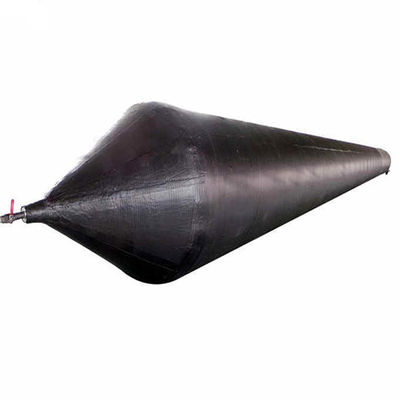
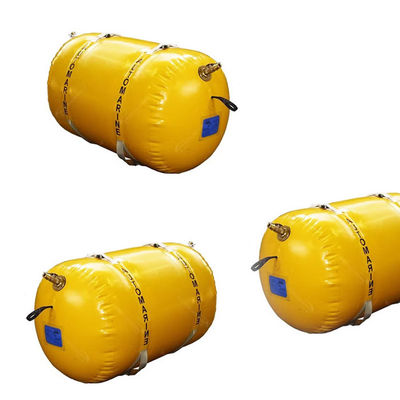
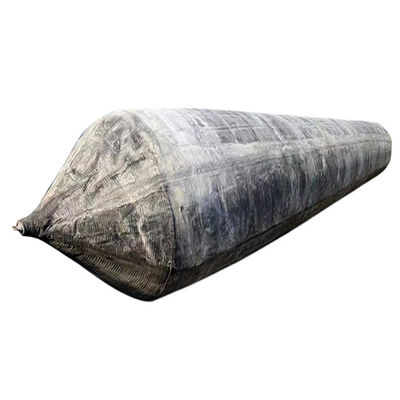
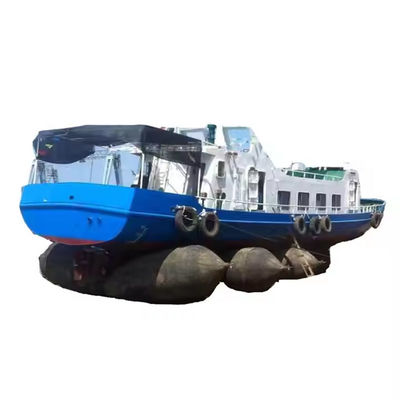
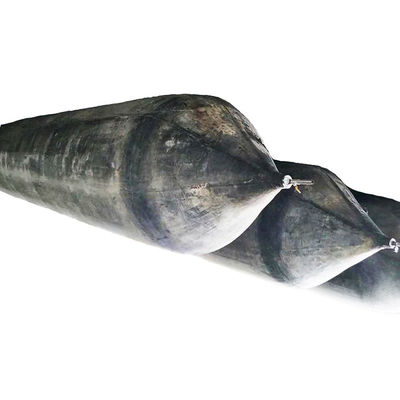
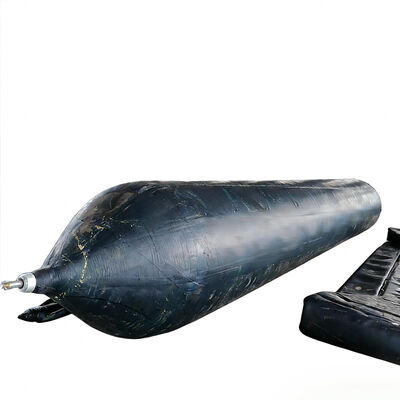
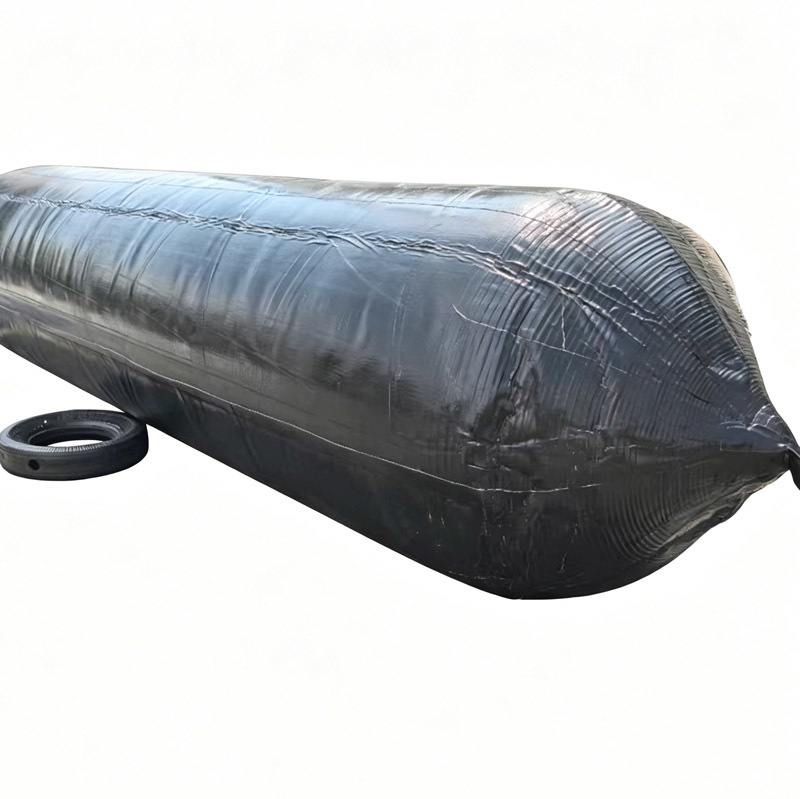
Ship Launching Airbags are engineered marine lifting and launching components designed for vessel launching, landing, and repositioning operations within shipbuilding and marine engineering environments. The product is manufactured using multi-layer reinforced synthetic tire cord fabric combined with high-strength elastomeric rubber compounds, forming a cylindrical structural body with controlled deformation characteristics under high internal pressure conditions.
The structural manufacturing process includes precision layering, high-pressure vulcanization bonding, and reinforcement alignment to ensure uniform stress distribution across the airbag body. The operating principle is based on pneumatic inflation, where internal pressure generates lifting force and rolling motion, enabling controlled transfer of vessel weight from land-based construction platforms to water environments.
From an engineering perspective, Ship Launching Airbags function as a flexible load-bearing interface system, replacing rigid slipway structures and reducing dependency on permanent dry dock infrastructure. The system provides controlled friction reduction, adaptive load dispersion across hull contact surfaces, and structural compliance with uneven ground conditions. The material system is designed to resist seawater corrosion, mechanical abrasion, and cyclic fatigue loading under repetitive industrial use conditions.
A coastal shipbuilding facility in Nigeria was assigned a 2,600-ton cargo vessel launching project. The shipyard operated in a semi-developed industrial zone without dry dock infrastructure and with limited ground reinforcement capability. The operational environment presented uneven soil density, seasonal humidity variation, and restricted heavy lifting equipment availability.
The main engineering challenge was to execute a controlled vessel launching process while maintaining hull structural integrity under unstable ground support conditions. Conventional launching methods were not applicable due to high infrastructure cost and long construction timelines.
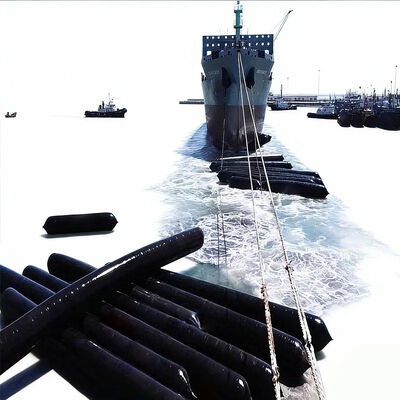
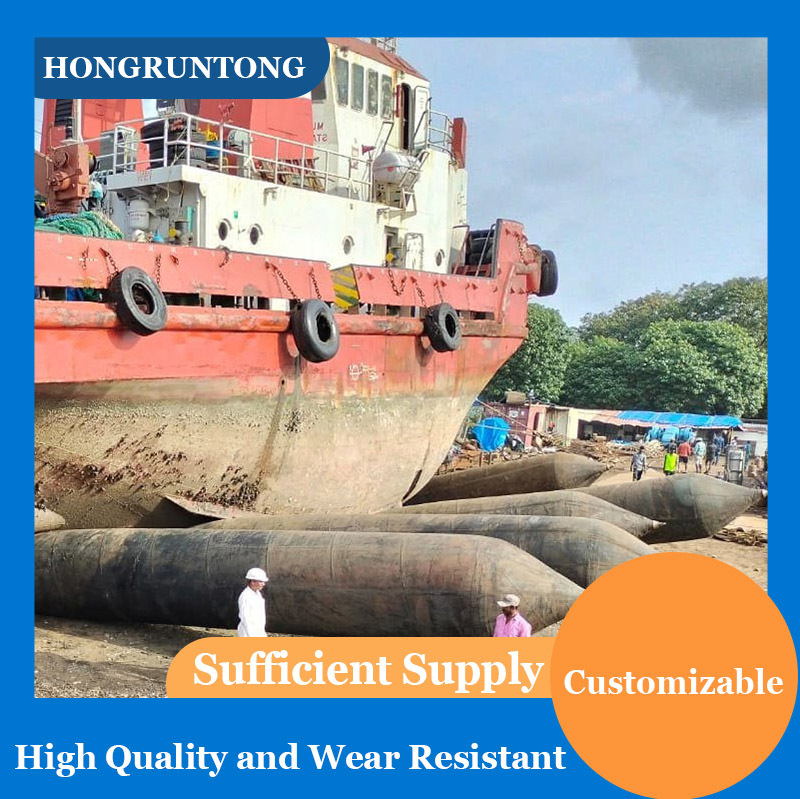
Ship Launching Airbags were deployed as the primary launching system. The engineering process involved calculated positioning of reinforced airbags under the vessel hull, followed by staged pneumatic inflation to achieve controlled lifting and rolling displacement toward the shoreline. Load distribution was continuously monitored during the operation to maintain structural balance and prevent localized stress concentration.
The vessel was successfully launched without structural deformation or surface damage. Operational analysis confirmed improved load stability, reduced friction resistance, and controlled transition dynamics. The project demonstrated high repeatability potential for future vessel operations within the same facility, significantly improving overall shipyard operational capability.
| Item | Description |
|---|---|
| Place of Origin | China |
| Brand Name | Hongruntong Marine |
| Product Name | Ship Launching Airbags |
| Material | Top-Notch Natural Rubber |
| Diameter | 0.5m-3.0m, or As Request |
| Length | 1.0m-28.0m, or As Request |
| Working Pressure | 0.05-0.25 Mpa |
| Technics | High Pressure, Overall Winding, Explosion-Proof |
| Use | ship launching and docking |
| Thickness | 5-15 ply |
| Standard | Conducted by ISO14409 and GB/T1590-2006 system. |
| Accessories | Q355/SS304/SS316, Pressure Gauge, Tee, Plug, Switch, Inflation Tube |
| Packaging | Inner-Plastic Bag; Outer-Standard Wooden Pallets. |
| Keywords | Marine Rubber Airbags for Ship Launching |
| Certificates | ABS, BV, KR, LR, GL, NK, RINA, DNV, RMRS |
| MOQ | 1 |
| OEM | Welcome |
| Diameter | Working Pressure | Working Height | Bearing Capacity KN/m | Bearing Capacity Ton/m |
|---|---|---|---|---|
| D=1.0m | 0.14Mpa | 0.6m | 87.96 | 8.98 |
| 0.5m | 109.96 | 11.22 | ||
| 0.4m | 131.95 | 13.46 | ||
| D=1.2m | 0.12Mpa | 0.7m | 94.25 | 9.62 |
| 0.6m | 113.10 | 11.54 | ||
| 0.5m | 131.95 | 13.46 | ||
| 0.4m | 150.80 | 15.39 | ||
| D=1.5m | 0.10Mpa | 0.9m | 94.25 | 9.62 |
| 0.8m | 109.96 | 11.22 | ||
| 0.7m | 125.66 | 12.82 | ||
| 0.6m | 141.37 | 14.43 | ||
| 0.5m | 157.08 | 16.03 | ||
| D=1.8m | 0.09Mpa | 1.1m | 98.96 | 10.10 |
| 1.0m | 113.10 | 11.54 | ||
| 0.9m | 127.33 | 12.98 | ||
| 0.8m | 141.37 | 14.43 | ||
| 0.7m | 155.51 | 15.87 | ||
| 0.6m | 169.65 | 17.31 | ||
| D=2.0m | 0.08Mpa | 1.2m | 100.53 | 10.26 |
| 1.1m | 113.10 | 11.54 | ||
| 1.0m | 125.66 | 12.82 | ||
| 0.9m | 138.23 | 14.11 | ||
| 0.8m | 150.80 | 15.39 | ||
| 0.7m | 163.36 | 16.67 | ||
| 0.6m | 175.93 | 17.95 |
Ship Launching Airbags utilize a multi-layer synthetic tire cord reinforcement structure embedded within high-strength elastomeric rubber compounds. This configuration increases tensile strength and internal pressure resistance while ensuring uniform load distribution across the cylindrical body. The structural principle is based on layered stress dispersion, enabling stable mechanical performance under high compression and dynamic rolling conditions.
The system operates through controlled pneumatic inflation, where internal air pressure is converted into mechanical lifting and directional rolling forces. This mechanism enables gradual load transfer with reduced impact forces, ensuring controlled displacement of vessel weight and minimizing structural stress concentration on hull and ground contact interfaces.
The external elastomeric surface is engineered for resistance to seawater corrosion, ultraviolet radiation, and abrasive mechanical interaction. The material composition is optimized for marine environmental adaptability, ensuring long-term structural stability under coastal humidity, saline exposure, and repeated mechanical loading cycles.
The airbag system is engineered for repeated inflation and deflation cycles under industrial operating conditions. Fatigue resistance is achieved through controlled elasticity modulation, reinforcement layer bonding optimization, and stress distribution balancing, ensuring extended operational lifecycle and stable performance across multiple usage cycles.
The system is applied in shipyards for controlled vessel launching operations where dry dock infrastructure is unavailable or economically impractical. It supports cargo ships, fishing vessels, barges, and offshore service vessels, enabling structured transition from land fabrication zones to marine environments.
The product is used in marine salvage operations for refloating grounded vessels and assisting structural repositioning tasks. Its flexible load-bearing structure enables adaptation to irregular hull geometry and unstable seabed conditions during recovery operations.
The system is applied in offshore engineering and heavy industrial environments for transportation and deployment of large structural modules. It provides operational adaptability in coastal construction zones and industrial sites lacking permanent lifting infrastructure systems.
Hongruntong Marine operates a specialized manufacturing system focused on reinforced marine pneumatic structural products. The production process integrates composite material engineering, vulcanization control technology, and reinforcement alignment systems to ensure consistent structural performance under industrial load conditions.
Each product undergoes multi-stage mechanical testing including internal pressure validation, deformation behavior assessment, and fatigue cycle simulation. The quality control system is designed to ensure compliance with marine engineering operational requirements and structural reliability under high-load environments.
The company provides engineering customization based on vessel specifications, hull geometry, and operational site conditions. Technical design support includes load calculation, deployment configuration planning, and operational guidance to ensure optimized system performance in real-world applications.
Hongruntong Marine maintains a global supply and technical support system covering logistics delivery, installation guidance, operational training, and post-deployment technical assistance. The system ensures consistent supply reliability and engineering support for international marine and shipbuilding projects.
The load capacity is determined by airbag diameter, reinforcement structure, and system configuration. The system is engineered to support a wide range of vessel tonnage when deployed in properly calculated combinations.
Service life depends on operational frequency, environmental exposure, and maintenance procedures. Under standard industrial usage with proper handling, the system supports repeated operational cycles over extended service periods.
Pressure is controlled through industrial air compression systems equipped with calibrated monitoring instruments. The inflation process is executed in staged sequences to maintain uniform pressure distribution and operational stability.
The system is engineered for coastal, offshore, and industrial marine environments. It maintains structural stability under high humidity, saline exposure, and variable ground conditions commonly encountered in shipyard operations.
Yes. The structural design supports repeated inflation and deflation cycles. With proper inspection and maintenance procedures, the system maintains stable mechanical performance across multiple industrial applications.