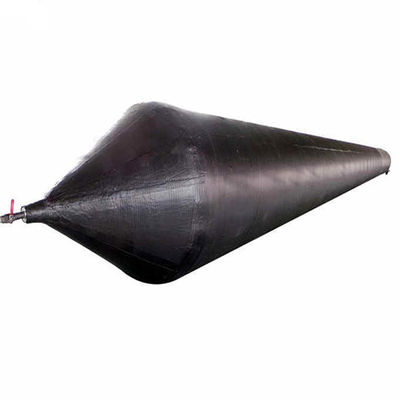
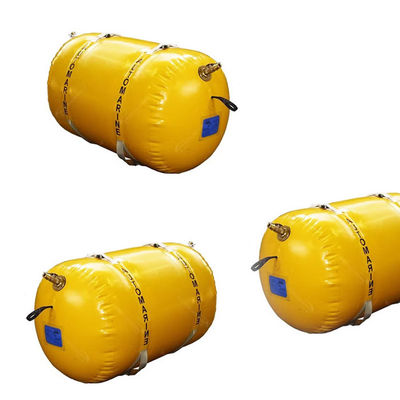
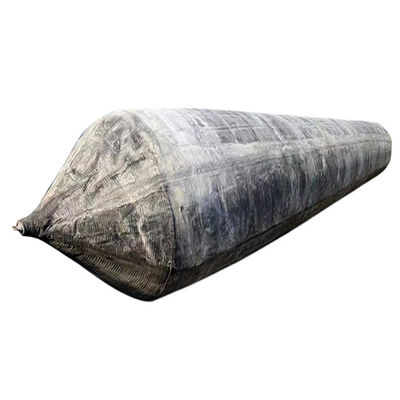
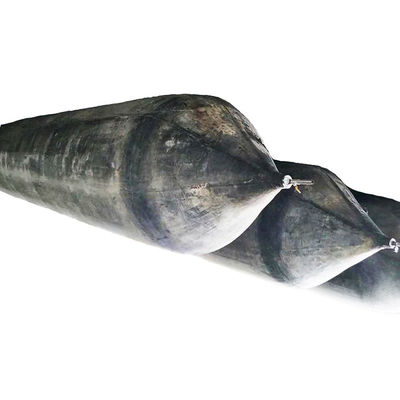
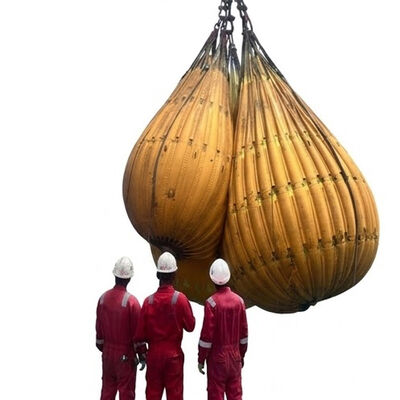
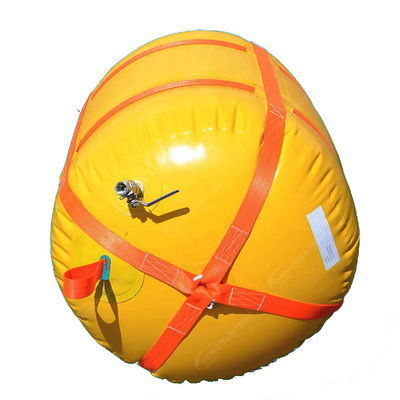
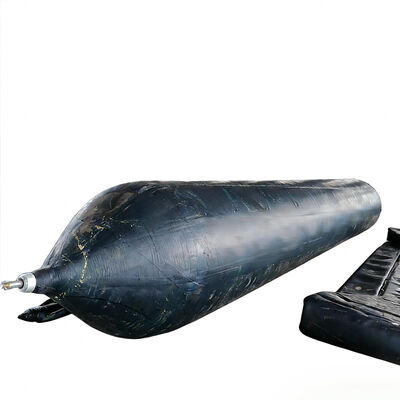
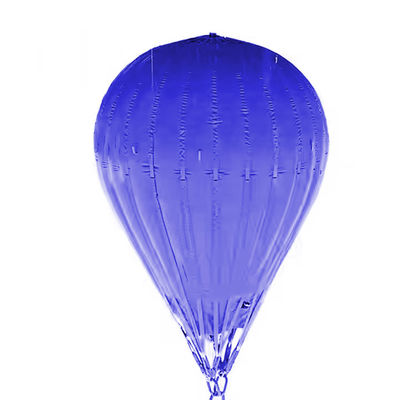
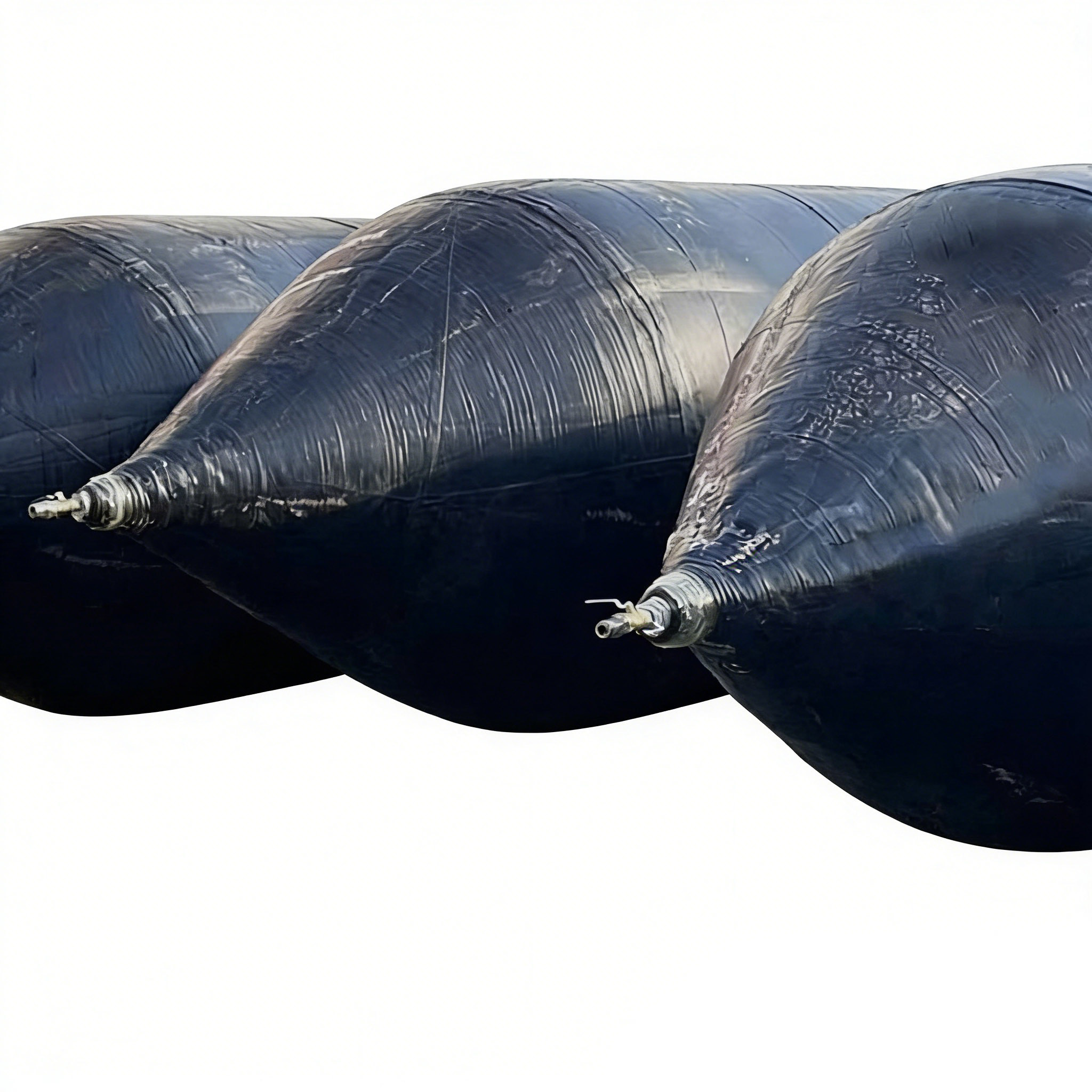
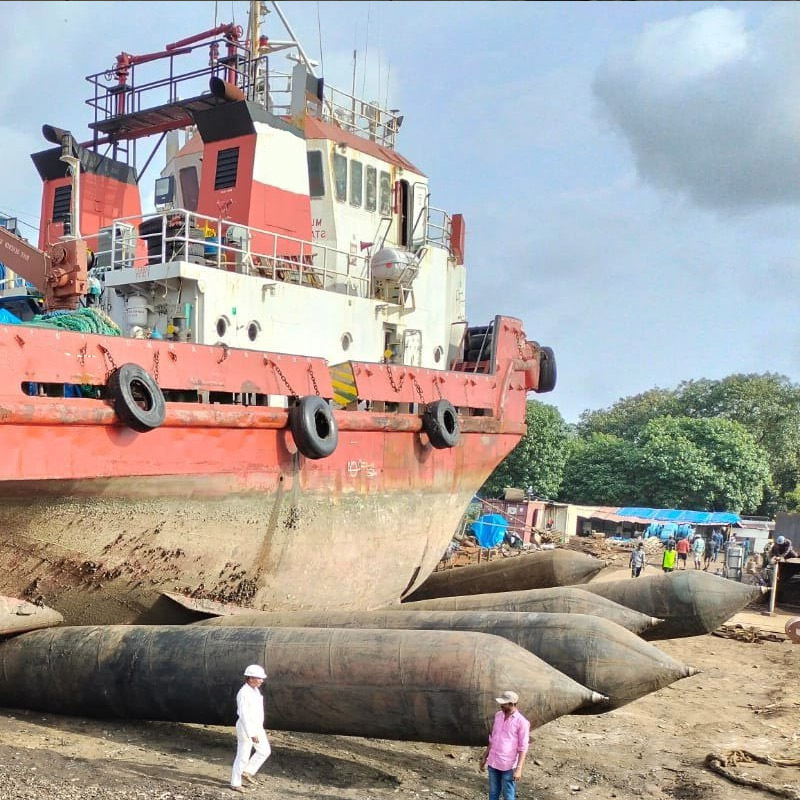
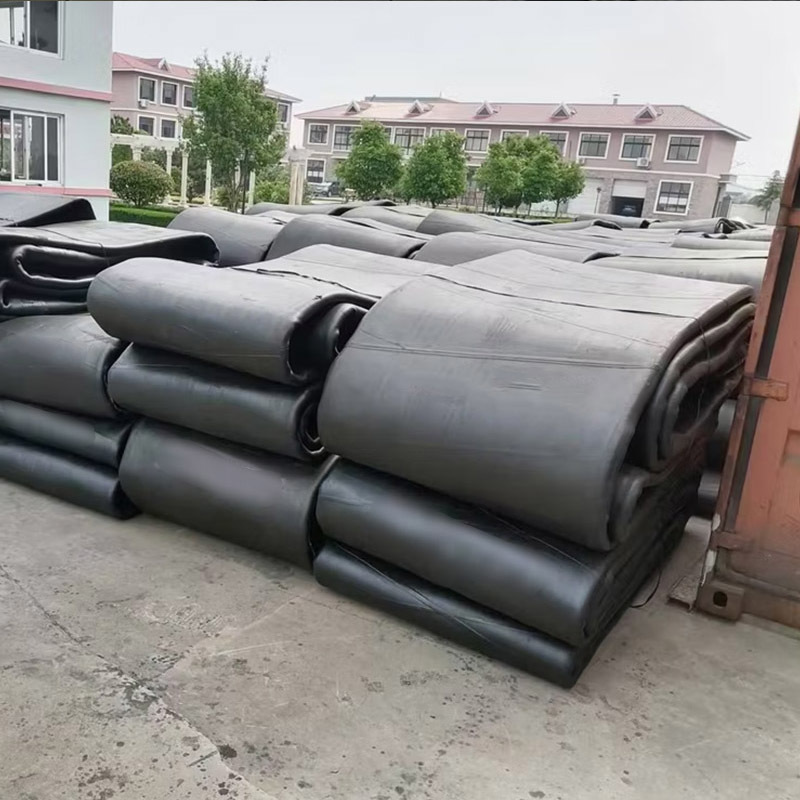
Marine Rubber Airbags are highly reliable marine engineering devices designed for ship launching, vessel landing, and heavy structure transportation. These airbags are manufactured using premium natural rubber and multiple layers of high-strength synthetic tire cord reinforcement, forming a durable composite structure capable of supporting extremely heavy loads while maintaining excellent elasticity and stability.
The reinforced internal cord layers are arranged at specific angles to create a strong pressure-bearing framework that allows the airbag to withstand high internal inflation pressure and dynamic loads during marine operations. The outer rubber layer is developed with advanced abrasion-resistant and weather-resistant compounds to ensure long-term durability in harsh coastal environments.
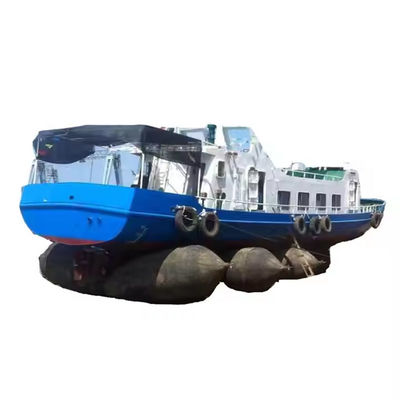
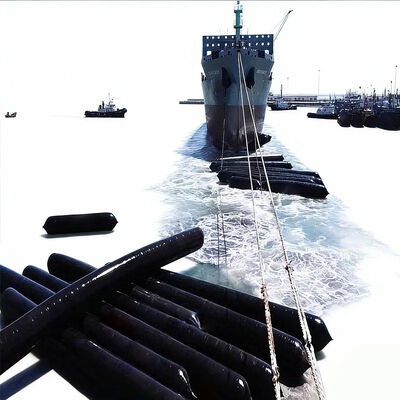
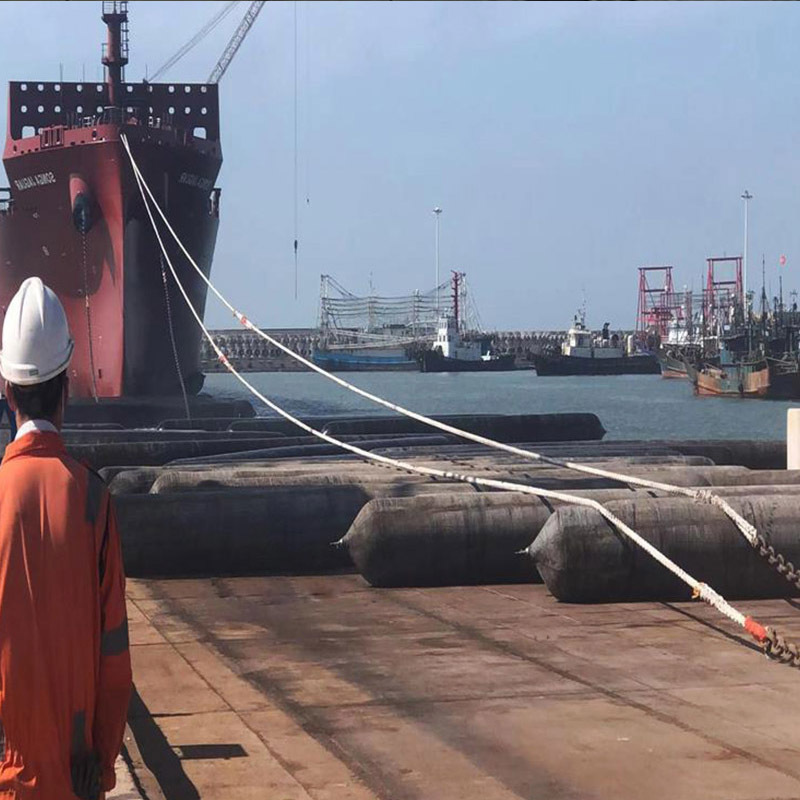
A shipbuilding facility in Eastern Europe successfully launched a 4,500 DWT multipurpose cargo vessel using our marine airbag system. The vessel, measuring approximately 95 meters in length with a displacement of nearly 4,000 tons, was launched using 12 marine airbags (1.6m diameter, 15m length) arranged beneath the hull.
The airbags were inflated gradually to recommended working pressure, forming a stable rolling platform. As the vessel moved toward the water, the airbags rolled smoothly while maintaining continuous contact with the hull, adapting to ground variations and hull geometry. The operation was completed successfully with no structural stress or operational difficulties, significantly reducing project costs and preparation time compared to traditional launching infrastructure.
| Product Name | Marine Rubber Airbags |
|---|---|
| Keywords | Marine Airbag for Ship Launching |
| Material | 100% High Tensile NR |
| Dimensions | Diameter 0.5m - 3.0m, Length 3.0m - 28.0m, or as Request |
| Working Pressure | 0.05-0.25MPA |
| Technology | Overall Winding, High Pressure, Explosion Proof |
| Metal Parts | Q355 / SS304 / SS316 |
| OEM | Supported |
| MOQ | 1 |
| Repair Tools | Electric Heating Plate, Repair Materials, Glue, Free of Charge |
| Standard | ISO14409:2011 |
| Certificate | ABS, BV, KR, LR, GL, NK, RINA, DNV, RMRS |
| Package | Pallets, Wooden Cases |
| Service Life | 20 Years |
| Warranty | 36 Months |
| Diameter | Working Pressure | Working Height | Bearing Capacity KN/m | Bearing Capacity Ton/m |
|---|---|---|---|---|
| D=1.0m | 0.14Mpa | 0.6m | 87.96 | 8.98 |
| D=1.0m | 0.14Mpa | 0.5m | 109.96 | 11.22 |
| D=1.0m | 0.14Mpa | 0.4m | 131.95 | 13.46 |
| D=1.2m | 0.12Mpa | 0.7m | 94.25 | 9.62 |
| D=1.2m | 0.12Mpa | 0.6m | 113.10 | 11.54 |
| D=1.2m | 0.12Mpa | 0.5m | 131.95 | 13.46 |
| D=1.2m | 0.12Mpa | 0.4m | 150.80 | 15.39 |
| D=1.5m | 0.10Mpa | 0.9m | 94.25 | 9.62 |
| D=1.5m | 0.10Mpa | 0.8m | 109.96 | 11.22 |
| D=1.5m | 0.10Mpa | 0.7m | 125.66 | 12.82 |
| D=1.5m | 0.10Mpa | 0.6m | 141.37 | 14.43 |
| D=1.5m | 0.10Mpa | 0.5m | 157.08 | 16.03 |
| D=1.8m | 0.09Mpa | 1.1m | 98.96 | 10.10 |
| D=1.8m | 0.09Mpa | 1.0m | 113.10 | 11.54 |
| D=1.8m | 0.09Mpa | 0.9m | 127.33 | 12.98 |
| D=1.8m | 0.09Mpa | 0.8m | 141.37 | 14.43 |
| D=1.8m | 0.09Mpa | 0.7m | 155.51 | 15.87 |
| D=1.8m | 0.09Mpa | 0.6m | 169.65 | 17.31 |
| D=2.0m | 0.08Mpa | 1.2m | 100.53 | 10.26 |
| D=2.0m | 0.08Mpa | 1.1m | 113.10 | 11.54 |
| D=2.0m | 0.08Mpa | 1.0m | 125.66 | 12.82 |
| D=2.0m | 0.08Mpa | 0.9m | 138.23 | 14.11 |
| D=2.0m | 0.08Mpa | 0.8m | 150.80 | 15.39 |
| D=2.0m | 0.08Mpa | 0.7m | 163.36 | 16.67 |
| D=2.0m | 0.08Mpa | 0.6m | 175.93 | 17.95 |
* Other sizes can be provided following client's requirements.
The size and number of airbags depend on vessel displacement, hull dimensions, launching slope, and ground conditions. Engineers calculate these factors to determine the optimal configuration for safe operation.
Yes, high quality marine airbags are designed for multiple launching operations. With proper maintenance and correct operating procedures, they can provide long service life.
Airbags are typically inflated using industrial air compressors equipped with pressure gauges to ensure accurate control of internal pressure.
Yes, marine airbags can operate on various surfaces including compact soil, sand, and concrete, although smoother surfaces help extend service life.
Before each operation, the airbags should be inspected for surface damage, pressure retention capability, and valve condition to ensure safe and reliable performance.