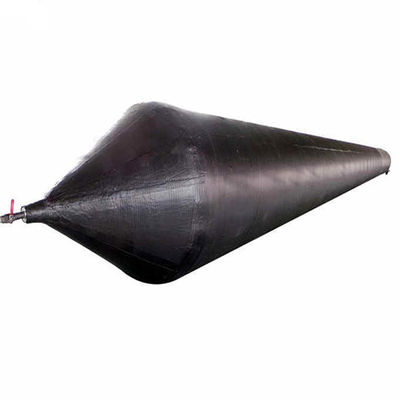
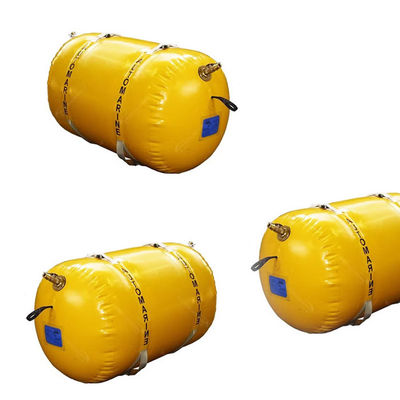
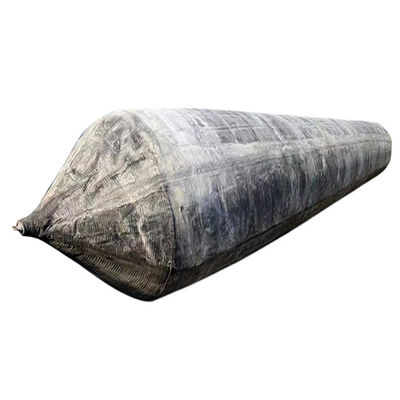
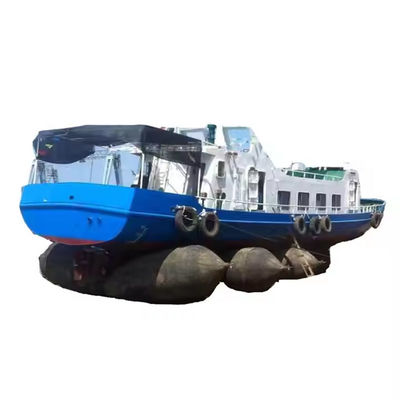
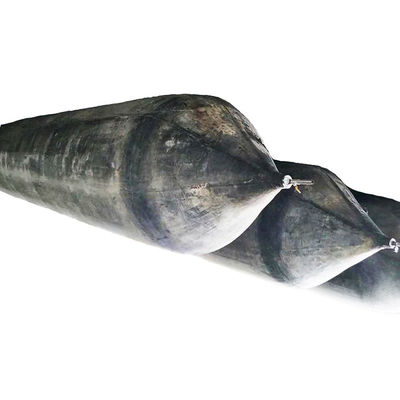
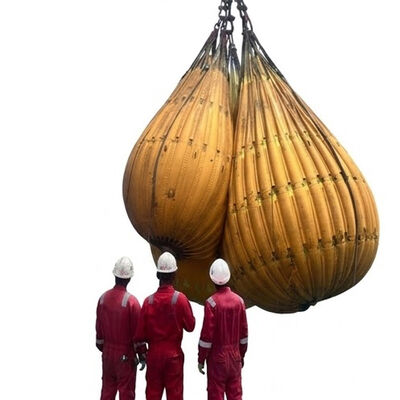
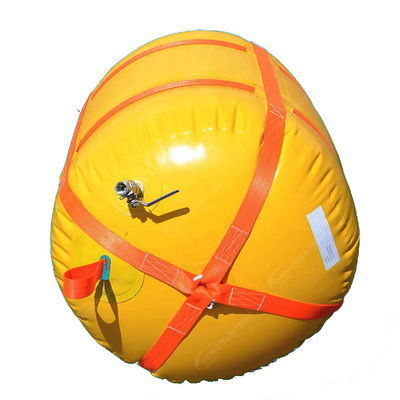
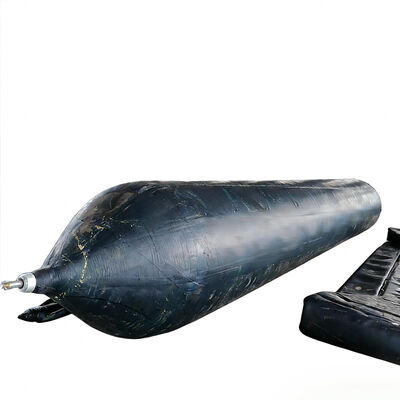
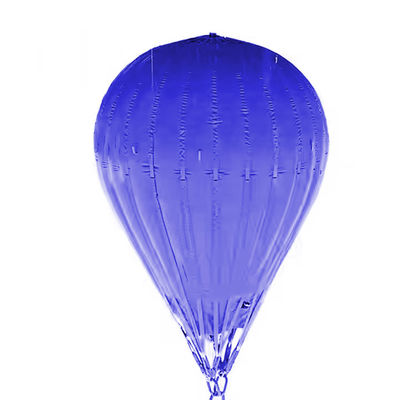
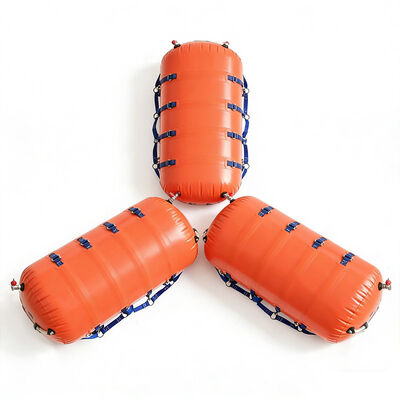
Underwater Lift Bags are inflatable buoyancy systems designed for controlled underwater lifting, temporary flotation, load stabilization, and positioning of submerged structures and equipment. The system uses enclosed air to displace water and generate upward buoyant force, allowing the effective submerged weight of a load to be reduced during recovery, installation, relocation, or maintenance operations.
The flexible construction provides an alternative to large rigid lifting arrangements where underwater access, working space, transportation requirements, or load geometry create engineering limitations.
The main body is manufactured from high-strength synthetic reinforcement fabric with a durable rubber or elastomeric coating. The reinforcement layer provides tensile strength and dimensional stability, while the external layer protects the structure against abrasion, moisture, repeated folding, and normal contact with underwater surfaces.
Reinforced seams, load-bearing webbing, lifting points, inflation valves, and connection components are integrated into the product structure to provide a defined path for transferring buoyancy forces to the load.
The operating principle is based on controlled displacement. When compressed air is introduced, the bag expands and displaces surrounding water. The resulting buoyancy acts upward against the submerged load, reducing its effective underwater weight. The operator can control the lifting process by adjusting the air volume and using several bags at different lifting positions.
This provides greater flexibility when the load has an irregular shape, an offset center of gravity, or changing support conditions. For marine construction and recovery work, controlled buoyancy is often required at different stages rather than only at the final lifting position.
Project: Removal of 18-tonne steel construction frame from coastal maintenance zone in Japan
Challenge: Restricted working area, partially buried frame in compacted sediment and stones
Solution: Multiple Underwater Lift Bags positioned beneath structurally suitable sections with controlled progressive inflation
Result: Successful recovery with controlled movement, reduced mechanical handling demand, and reusable equipment for future projects
| Product Name | Underwater Lift Bags |
| Raw Material | PVC coating fabric |
| Type | Cylindrical |
| Size | 500kg, 1000kg, 5000kg, 10000kg, etc |
| Thickness | 0.4-1.2mm, or as requested |
| Color | Yellow, Blue, Black, etc |
| Density | 0.33-0.9g/cm³ |
| Safety Factor | 7:1 |
| Tolerances | ±0.03 on densities, ±0.2mm on thickness, ±0 to +3mm on width, ±0 to +3mm on length |
| Model | Buoyancy (kg) | Buoyancy (lbs) | Diameter (mm) | Length (mm) | Weight (kg) |
|---|---|---|---|---|---|
| HM-ULB01 | 200 | 441 | 500 | 1,000 | 5 |
| HM-ULB02 | 500 | 1,103 | 800 | 1,000 | 8 |
| HM-ULB03 | 1,000 | 2,205 | 1,000 | 1,500 | 11 |
| HM-ULB04 | 2,000 | 4,410 | 1,300 | 1,500 | 20 |
| HM-ULB05 | 4,000 | 8,820 | 1,600 | 2,000 | 50 |
| HM-ULB06 | 6,000 | 13,230 | 2,000 | 2,000 | 66 |
| HM-ULB07 | 8,000 | 17,640 | 2,000 | 2,600 | 75 |
| HM-ULB08 | 10,000 | 22,050 | 2,400 | 2,400 | 80 |
| HM-ULB09 | 15,000 | 33,075 | 2,600 | 3,000 | 110 |
| HM-ULB10 | 20,000 | 44,100 | 3,000 | 3,000 | 130 |
| HM-ULB11 | 30,000 | 66,150 | 3,000 | 4,500 | 170 |
| HM-ULB12 | 50,000 | 110,250 | 4,000 | 4,000 | 220 |
| HM-ULB13 | 70,000 | 154,350 | 4,000 | 5,700 | 310 |
| HM-ULB14 | 100,000 | 220,500 | 4,000 | 8,000 | 450 |
| HM-ULB15 | 150,000 | 330,750 | 5,000 | 8,000 | 660 |
| HM-ULB16 | 200,000 | 441,000 | 5,000 | 10,000 | 900 |
High-strength synthetic reinforcement provides tensile strength and dimensional stability for underwater load support. The internal reinforcement carries tensile forces while the external coating protects against abrasion, moisture, and mechanical contact.
Durable rubber or elastomeric coating withstands demanding contact conditions with steel structures, sediment, and rocky seabeds. The material maintains flexibility while providing excellent abrasion resistance for extended service life.
Progressive air introduction allows staged load reduction and precise buoyancy control. Operators can monitor load response and adjust inflation rates for optimal stability and safety during recovery operations.
Deflated equipment can be folded for compact storage and transportation. Flexible deployment adapts to various underwater geometries without requiring rigid lifting frames, supporting efficient equipment utilization across multiple projects.
Extensive expertise in marine product manufacturing with focus on reinforced rubber products, buoyancy equipment, and industrial applications. Established understanding of material selection and structural construction for reliable operational performance.
Careful selection of reinforcement fabric, coating systems, webbing, and components based on application requirements. Balanced approach combining strength, flexibility, durability, and handling characteristics.
Comprehensive production controls and inspection processes covering material preparation, assembly, reinforcement, seam construction, and final testing. Ensures consistency between manufactured products and technical specifications.
Project-oriented support from product selection through field deployment. Assistance with load analysis, configuration planning, installation procedures, and maintenance guidelines for optimal equipment performance.
Yes, they can assist with recovery of partially buried loads when properly engineered. Initial buoyancy reduces contact force before additional lifting force is applied. Seabed condition, degree of burial, and load geometry should be evaluated before deployment.
Quantity depends on submerged weight, required buoyancy, load dimensions, center of gravity, attachment locations, water depth, and desired load distribution. Large structures may require multiple units positioned at different locations.
Suitability depends on project environment, material specification, operating pressure, water depth, and required service duration. Long-term exposure should be evaluated according to specific project requirements with periodic condition monitoring.
After recovery: clean of contaminants, allow to dry, and visually inspect body, seams, lifting straps, connection points, valves, and inflation components. Store in dry environment away from sharp objects, excessive heat, and direct sunlight.
Yes, connection configurations can be adapted for specific lifting methods and load geometries. Options include reinforced lifting straps, specified connection points, and custom inflation arrangements based on project requirements.