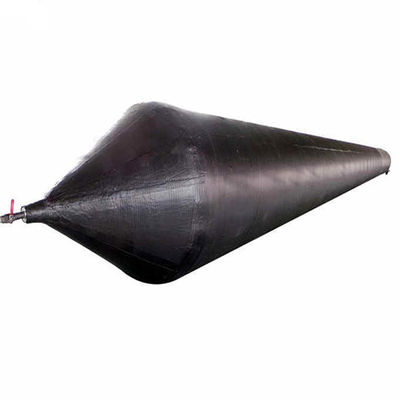
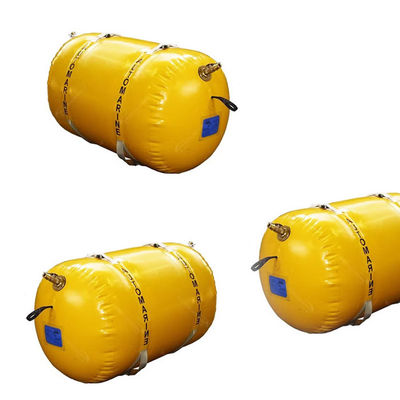
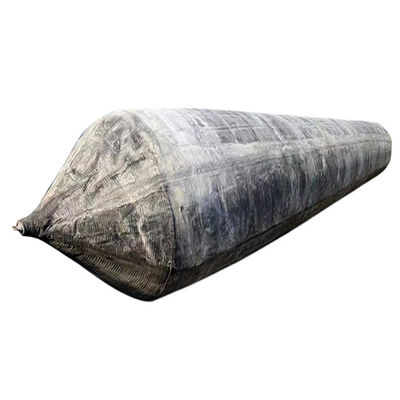
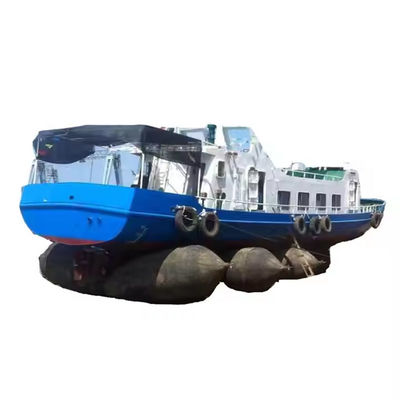
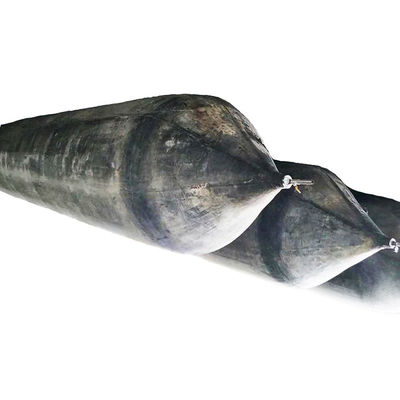
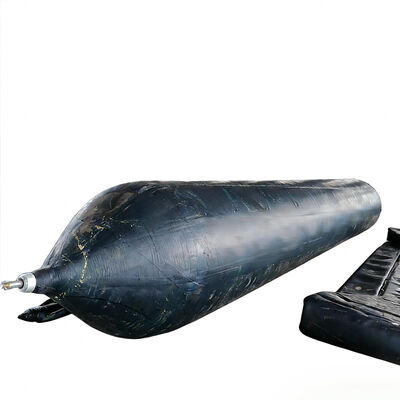
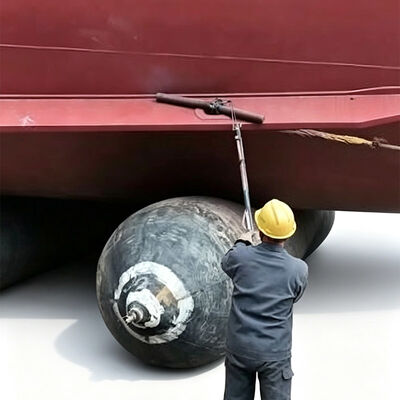
Marine Rubber Airbags are engineered inflatable load-support systems designed for ship launching, vessel landing, hull relocation, temporary support, and controlled marine transportation operations. These corrosion-resistant, cost-effective systems feature high load capacity through reinforced pneumatic structures.
| Product Name | Marine Rubber Airbags |
|---|---|
| Keywords | Marine Airbag for Ship Launching |
| Material | 100% High Tensile NR |
| Dimensions | Diameter 0.5m - 3.0m, Length 3.0m - 28.0m, or as Request |
| Working Pressure | 0.05-0.25MPA |
| Technology | Overall Winding, High Pressure, Explosion Proof |
| Metal Parts | Q355 / SS304 / SS316 |
| OEM | Supported |
| MOQ | 1 |
| Repair Tools | Electric Heating Plate, Repair Materials, Glue, Free of Charge |
| Standard | ISO14409:2011 |
| Certificate | ABS, BV, KR, LR, GL, NK, RINA, DNV, RMRS |
| Package | Pallets, Wooden Cases |
| Service Life | 20 Years |
| Warranty | 36 Months |
| Diameter | Working Pressure | Working Height | Bearing Capacity KN/m | Bearing Capacity Ton/m |
|---|---|---|---|---|
| D=1.0m | 0.14Mpa | 0.6m | 87.96 | 8.98 |
| D=1.0m | 0.14Mpa | 0.5m | 109.96 | 11.22 |
| D=1.0m | 0.14Mpa | 0.4m | 131.95 | 13.46 |
| D=1.2m | 0.12Mpa | 0.7m | 94.25 | 9.62 |
| D=1.2m | 0.12Mpa | 0.6m | 113.10 | 11.54 |
| D=1.2m | 0.12Mpa | 0.5m | 131.95 | 13.46 |
| D=1.2m | 0.12Mpa | 0.4m | 150.80 | 15.39 |
| D=1.5m | 0.10Mpa | 0.9m | 94.25 | 9.62 |
| D=1.5m | 0.10Mpa | 0.8m | 109.96 | 11.22 |
| D=1.5m | 0.10Mpa | 0.7m | 125.66 | 12.82 |
| D=1.5m | 0.10Mpa | 0.6m | 141.37 | 14.43 |
| D=1.5m | 0.10Mpa | 0.5m | 157.08 | 16.03 |
| D=1.8m | 0.09Mpa | 1.1m | 98.96 | 10.10 |
| D=1.8m | 0.09Mpa | 1.0m | 113.10 | 11.54 |
| D=1.8m | 0.09Mpa | 0.9m | 127.33 | 12.98 |
| D=1.8m | 0.09Mpa | 0.8m | 141.37 | 14.43 |
| D=1.8m | 0.09Mpa | 0.7m | 155.51 | 15.87 |
| D=1.8m | 0.09Mpa | 0.6m | 169.65 | 17.31 |
| D=2.0m | 0.08Mpa | 1.2m | 100.53 | 10.26 |
| D=2.0m | 0.08Mpa | 1.1m | 113.10 | 11.54 |
| D=2.0m | 0.08Mpa | 1.0m | 125.66 | 12.82 |
| D=2.0m | 0.08Mpa | 0.9m | 138.23 | 14.11 |
| D=2.0m | 0.08Mpa | 0.8m | 150.80 | 15.39 |
| D=2.0m | 0.08Mpa | 0.7m | 163.36 | 16.67 |
| D=2.0m | 0.08Mpa | 0.6m | 175.93 | 17.95 |
* Other sizes can be provided following client's requirements.
Utilizes internal pneumatic pressure as the primary mechanism for supporting external vessel loads. The reinforcement system limits excessive radial expansion and distributes tensile stress throughout the body, providing both load-bearing efficiency and operational flexibility.
Features a composite structure with high-strength synthetic tire cord reinforcement embedded within durable rubber matrix. This provides structural stability while allowing sufficient deformation for effective contact interface.
Outer rubber layer is specifically designed for wear resistance, protecting the internal reinforcement from abrasion during repeated handling cycles and supporting long-term durability.
Can be deployed without permanent installation, adapted to different vessel arrangements, and redeployed for multiple projects, providing practical infrastructure efficiency for shipyards and contractors.
A marine construction contractor in Southeast Asia successfully relocated a 7,000 ton flat-bottom barge using Marine Rubber Airbags. The project demonstrated the system's capability to handle high vessel weight in restricted working spaces without permanent infrastructure.
The airbags were inflated progressively to establish initial support, with pressure monitoring during load transfer. During movement, the airbags operated as a rolling support system with coordinated repositioning, allowing continuous relocation without interruptions.
The contractor avoided constructing permanent transfer tracks and retained the equipment for future projects, demonstrating the reusable nature and operational flexibility of the system.
Extensive expertise in marine rubber products and equipment, with practical knowledge of materials and production processes for pressure-bearing marine applications.
Ability to configure airbags with different diameters, lengths, reinforcement arrangements, and pressure ratings according to specific project requirements.
Comprehensive production controls from material selection through final inspection to ensure dimensional consistency and structural quality.
International project support with technical communication, specification exchange, and delivery planning for global marine operations.
Diameter describes the inflated cross-sectional size, while effective working length refers to the portion available for load-bearing contact. Both parameters influence the effective supporting area and must be considered together.
Yes, when the route, vessel load, surface condition, and support arrangement are appropriately engineered. Longer movements require systematic repositioning and continuous monitoring.
Remove from service immediately and inspect before further use. Cuts, punctures, exposed reinforcement, or severe abrasion require professional assessment for repair or replacement.
Requires a suitable compressed-air source with compatible connections and reliable pressure monitoring to control inflation and avoid exceeding rated operating pressure.
Yes. Dimensions, reinforcement configuration, working pressure, end fittings, and other technical parameters can be customized. Specific testing and certification requirements should be communicated during specification.