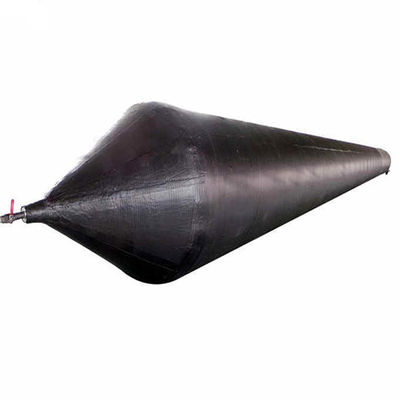
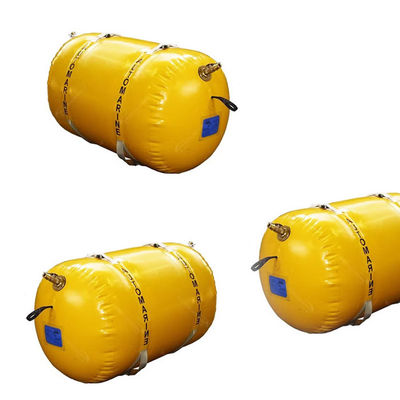
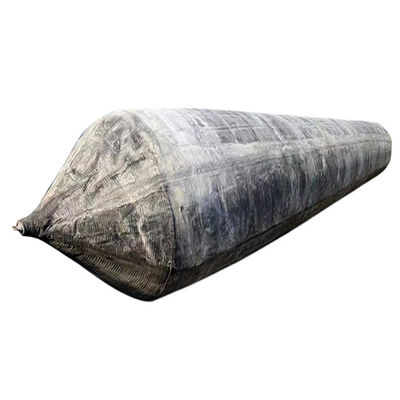
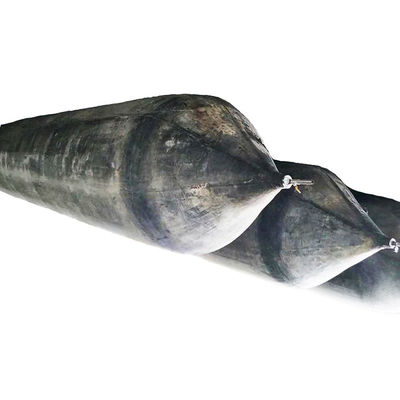
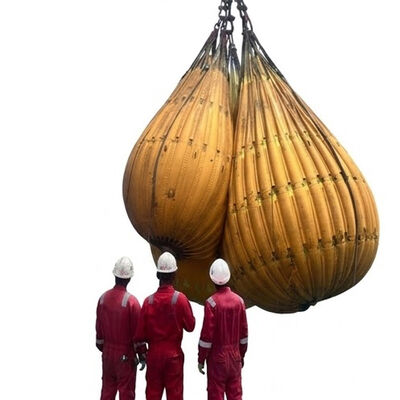
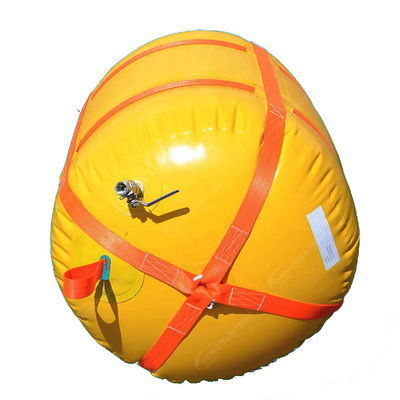
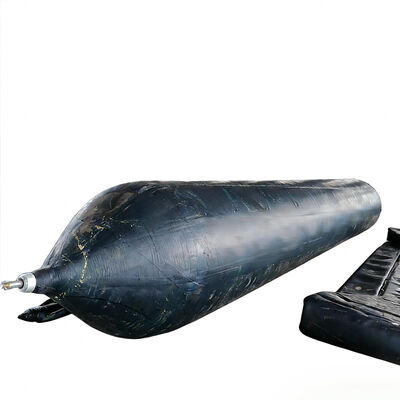
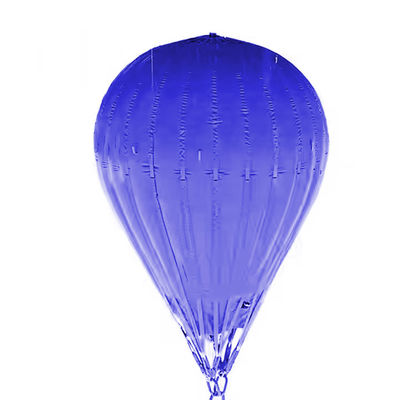
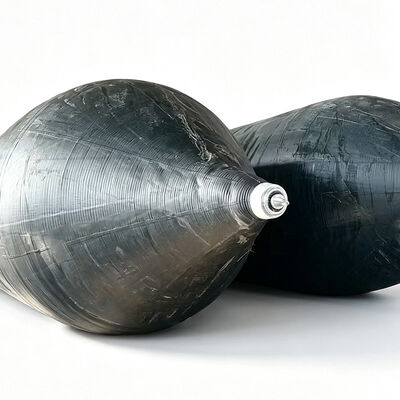
Marine Rubber Airbags are high-strength inflatable marine handling systems developed for vessel launching, landing, shifting, temporary hull support, and controlled load transfer in shipyards, coastal fabrication yards, and marine construction environments. The product uses internal air pressure to generate supporting force while a reinforced rubber structure distributes external vessel loads through the cylindrical body.
The main body is manufactured from abrasion-resistant rubber compounds reinforced with multiple layers of high-strength synthetic tire cord. The reinforcement system provides tensile strength and controls radial expansion when the internal pressure increases. The inner rubber layer maintains air retention, while the outer rubber layer protects the reinforcement against mechanical contact and environmental exposure.
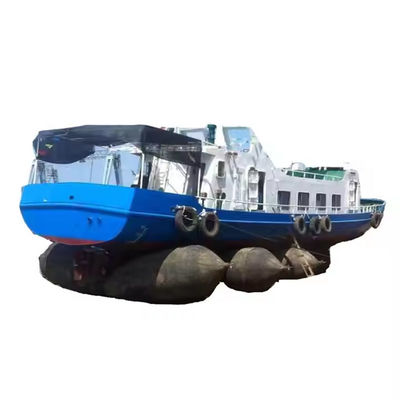
A ship repair company located on the Bohai Sea coast required a temporary landing solution for a 5,200 ton bulk carrier undergoing extensive underwater hull inspection and external coating maintenance. The facility had a large reinforced shore area but did not have a dry dock capable of accommodating the vessel's beam and overall dimensions.
Marine Rubber Airbags were selected according to the vessel weight, hull dimensions, support requirements, and operating pressure. The airbags were positioned at predetermined longitudinal intervals, with the arrangement designed to establish progressive contact beneath the hull. Each unit was inspected before inflation, and the valves and pressure-control components were checked before load transfer began.
| Parameter | Specification |
|---|---|
| Product Name | Marine Rubber Airbags |
| Material | 100% High Tensile NR |
| Dimensions | Diameter 0.5m - 3.0m, Length 3.0m - 28.0m, or as Request |
| Working Pressure | 0.05-0.25MPA |
| Technology | Overall Winding, High Pressure, Explosion Proof |
| Metal Parts | Q355 / SS304 / SS316 |
| Standard | ISO14409:2011 |
| Certificates | ABS, BV, KR, LR, GL, NK, RINA, DNV, RMRS |
| Service Life | 20 Years |
| Warranty | 36 Months |
| Diameter | Working Pressure | Working Height | Bearing Capacity (KN/m) | Bearing Capacity (Ton/m) |
|---|---|---|---|---|
| D=1.0m | 0.14Mpa | 0.6m | 87.96 | 8.98 |
| D=1.0m | 0.14Mpa | 0.5m | 109.96 | 11.22 |
| D=1.0m | 0.14Mpa | 0.4m | 131.95 | 13.46 |
| D=1.2m | 0.12Mpa | 0.7m | 94.25 | 9.62 |
| D=1.2m | 0.12Mpa | 0.6m | 113.10 | 11.54 |
| D=1.2m | 0.12Mpa | 0.5m | 131.95 | 13.46 |
| D=1.2m | 0.12Mpa | 0.4m | 150.80 | 15.39 |
| D=1.5m | 0.10Mpa | 0.9m | 94.25 | 9.62 |
| D=1.5m | 0.10Mpa | 0.8m | 109.96 | 11.22 |
| D=1.5m | 0.10Mpa | 0.7m | 125.66 | 12.82 |
| D=1.5m | 0.10Mpa | 0.6m | 141.37 | 14.43 |
| D=1.5m | 0.10Mpa | 0.5m | 157.08 | 16.03 |
| D=1.8m | 0.09Mpa | 1.1m | 98.96 | 10.10 |
| D=1.8m | 0.09Mpa | 1.0m | 113.10 | 11.54 |
| D=1.8m | 0.09Mpa | 0.9m | 127.33 | 12.98 |
| D=1.8m | 0.09Mpa | 0.8m | 141.37 | 14.43 |
| D=1.8m | 0.09Mpa | 0.7m | 155.51 | 15.87 |
| D=1.8m | 0.09Mpa | 0.6m | 169.65 | 17.31 |
| D=2.0m | 0.08Mpa | 1.2m | 100.53 | 10.26 |
| D=2.0m | 0.08Mpa | 1.1m | 113.10 | 11.54 |
| D=2.0m | 0.08Mpa | 1.0m | 125.66 | 12.82 |
| D=2.0m | 0.08Mpa | 0.9m | 138.23 | 14.11 |
| D=2.0m | 0.08Mpa | 0.8m | 150.80 | 15.39 |
| D=2.0m | 0.08Mpa | 0.7m | 163.36 | 16.67 |
| D=2.0m | 0.08Mpa | 0.6m | 175.93 | 17.95 |
* Other sizes can be provided following client's requirements.
Marine Rubber Airbags use a composite construction in which rubber and synthetic reinforcement work together as a pressure-bearing structure. The internal air pressure generates radial expansion, while the reinforcement layers restrict uncontrolled deformation and distribute tensile forces throughout the cylindrical body.
The cylindrical geometry provides an extended contact area that can distribute vessel loads along the hull. When multiple units are positioned at appropriate intervals, the vessel's weight can be transferred through a series of support zones rather than concentrated at individual lifting points.
The external rubber layer is designed to withstand routine mechanical contact encountered during installation, rolling, repositioning, and storage. The material system also needs to remain stable under common marine environmental conditions including moisture, saltwater, and outdoor exposure.
Pressure management is a fundamental part of Marine Rubber Airbag operation. The inflation system allows compressed air to be introduced progressively so that the operator can establish the required support condition before transferring the full vessel load.
With over 30 years of manufacturing experience in marine rubber products, Hongruntong Marine maintains coordinated control of rubber compounds, synthetic reinforcement, molding, bonding, curing, fittings, and final inspection.
We evaluate project parameters such as vessel weight, dimensions, hull configuration, launching conditions, working surface, required pressure, and support arrangement when preparing technical specifications.
Our production inspection focuses on structural consistency, including material condition, reinforcement placement, rubber bonding, dimensions, fittings, and pressure-related performance.
We provide detailed specification data and technical communication for customers evaluating Marine Rubber Airbags for international applications, covering product configuration, operating pressure, installation considerations, and maintenance procedures.
The main information includes vessel weight or displacement, overall length, beam, hull configuration, launching or landing method, working surface, required movement distance, and available operating space.
Yes, the product is designed for marine applications and uses rubber materials intended for exposure to common marine conditions. However, prolonged saltwater contamination should be followed by appropriate cleaning and drying.
The airbags should be fully deflated and cleaned after use. Operators should inspect the outer rubber for cuts, abrasion, punctures, abnormal deformation, and embedded foreign material. Valves and end fittings should also be checked.
Operating pressure must remain within the manufacturer's specified working range. Increasing pressure beyond the rated condition can increase structural stress and may compromise safety and service life.
Yes. Customized dimensions, reinforcement structures, working pressures, effective lengths, and end-fitting arrangements can be evaluated according to the application.