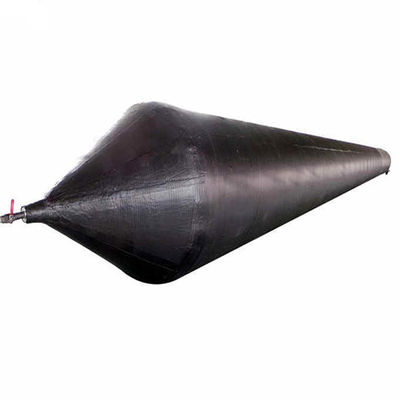
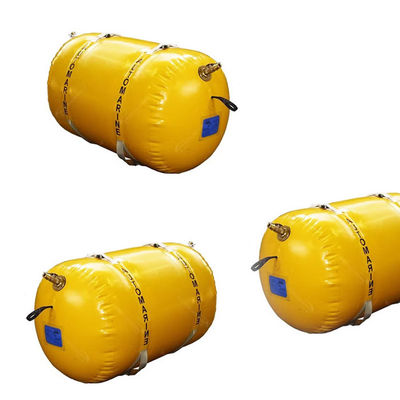
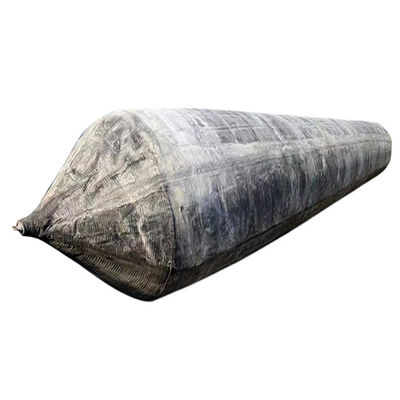
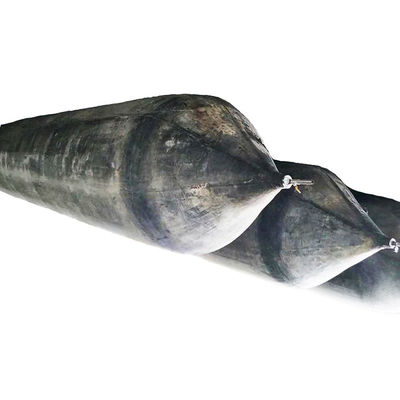
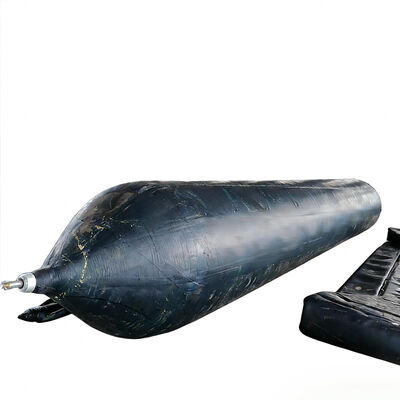
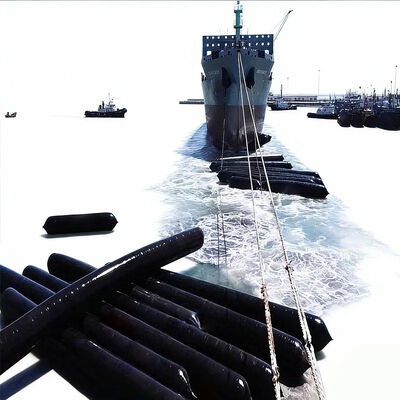
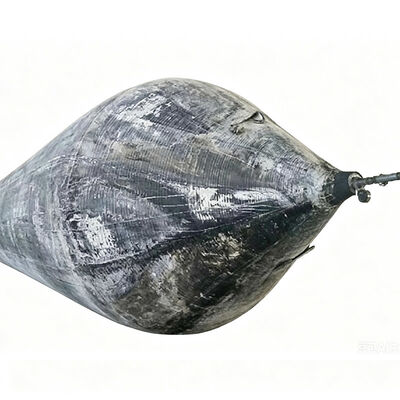
Marine Air Bag is a high-strength inflatable rubber system developed for ship launching, vessel transfer, and marine heavy-load support operations. It is manufactured using multi-layer synthetic tire cord reinforcement combined with high-performance vulcanized rubber, forming a cylindrical elastic structure capable of sustaining extreme compressive and dynamic rolling forces during shipyard operations.
The system is engineered to operate under controlled high-pressure conditions, typically ranging from 0.16 MPa to 0.28 MPa depending on vessel weight and structural configuration. This allows stable support of medium to large vessels during launching and landing operations while maintaining controlled deformation behavior.
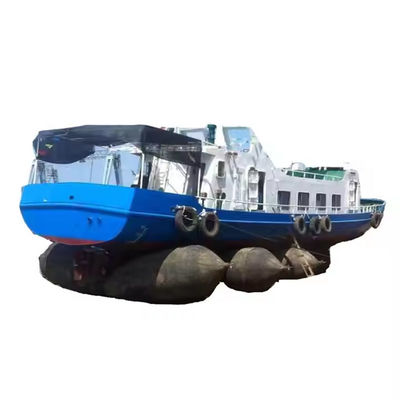
Marine Air Bags function through a rolling-contact mechanism that replaces rigid slipway friction with elastic rolling motion. This significantly reduces hull stress concentration and minimizes coating damage during vessel movement. The system also improves operational precision by allowing gradual and controlled water entry.
The outer rubber layer is designed with industrial-grade wear-resistant compounds, providing resistance to seawater corrosion, oil exposure, UV radiation, and mechanical abrasion. The internal reinforcement layers ensure structural integrity under repeated cyclic loading conditions.
This system is widely used as a flexible alternative to fixed dry dock infrastructure, enabling shipyards to operate in cost-limited or infrastructure-limited environments while maintaining high efficiency and safety standards.
A South American river shipyard was tasked with launching a 2,200 DWT river cargo vessel intended for inland waterway transportation. The facility was located in a constrained geographic environment with soft soil foundation and no permanent slipway infrastructure, making traditional launching methods unsafe and unstable.
Hongruntong Marine provided a customized Marine Air Bag system with 1.2m diameter and 8-layer reinforcement structure optimized for soft ground load distribution. A total of 14 airbags were deployed under the vessel using a reinforced wooden support framework to stabilize initial positioning.
During the launching process, the vessel was gradually transferred toward water using controlled rolling movement. The system successfully compensated for uneven ground pressure by dynamically distributing load across multiple airbags, preventing localized sinking or structural imbalance.
The launch was completed within 52 minutes without hull deformation or instability. The client reported a 48 percent reduction in total operational cost compared to crane-assisted launching methods and confirmed improved safety performance under soft soil conditions. The system was later adopted for all inland vessel production operations.
| Product Name | Marine Air Bag |
| Material | 100% High Tensile NR |
| Dimensions | Diameter 0.5m - 3.0m, Length 3.0m - 28.0m, or as Request |
| Working Pressure | 0.05-0.25MPA |
| Technology | Overall Winding, High Pressure, Explosion Proof |
| Metal Parts | Q355 / SS304 / SS316 |
| OEM | Supported |
| MOQ | 1 |
| Repair Tools | Electric Heating Plate, Repair Materials, Glue, Free of Charge |
| Standard | ISO14409:2011 |
| Certificate | ABS, BV, KR, LR, GL, NK, RINA, DNV, RMRS |
| Package | Pallets, Wooden Cases |
| Service Life | 20 Years |
| Warranty | 36 Months |
| Diameter | Working Pressure | Working Height | Bearing Capacity KN/m | Bearing Capacity Ton/m |
|---|---|---|---|---|
| D=1.0m | 0.14Mpa | 0.6m | 87.96 | 8.98 |
| 0.5m | 109.96 | 11.22 | ||
| 0.4m | 131.95 | 13.46 | ||
| D=1.2m | 0.12Mpa | 0.7m | 94.25 | 9.62 |
| 0.6m | 113.10 | 11.54 | ||
| 0.5m | 131.95 | 13.46 | ||
| 0.4m | 150.80 | 15.39 | ||
| D=1.5m | 0.10Mpa | 0.9m | 94.25 | 9.62 |
| 0.8m | 109.96 | 11.22 | ||
| 0.7m | 125.66 | 12.82 | ||
| 0.6m | 141.37 | 14.43 | ||
| 0.5m | 157.08 | 16.03 | ||
| D=1.8m | 0.09Mpa | 1.1m | 98.96 | 10.10 |
| 1.0m | 113.10 | 11.54 | ||
| 0.9m | 127.33 | 12.98 | ||
| 0.8m | 141.37 | 14.43 | ||
| 0.7m | 155.51 | 15.87 | ||
| 0.6m | 169.65 | 17.31 | ||
| D=2.0m | 0.08Mpa | 1.2m | 100.53 | 10.26 |
| 1.1m | 113.10 | 11.54 | ||
| 1.0m | 125.66 | 12.82 | ||
| 0.9m | 138.23 | 14.11 | ||
| 0.8m | 150.80 | 15.39 | ||
| 0.7m | 163.36 | 16.67 | ||
| 0.6m | 175.93 | 17.95 |
* Other size can be provided follow client's requirements.
Marine Air Bags are engineered to distribute load evenly across unstable or soft ground conditions, ensuring stable vessel support even in non-standard shipyard environments.
The internal structure allows real-time pressure balancing during operation, ensuring uniform load distribution across multiple airbags and maintaining stable rolling behavior.
The cylindrical elastic structure adapts to varying hull shapes and weight distributions, enabling efficient support for different vessel categories without structural modification.
The outer layer is designed for repeated mechanical stress and environmental exposure, ensuring long service life under frequent shipyard operations.
Yes, the system is specifically designed to adapt to soft soil and uneven ground conditions with proper load distribution.
Marine Air Bags can be used for vessels starting from small industrial boats depending on configuration.
Stability is maintained through multi-point load distribution and synchronized pressure control across airbags.
Yes, they are widely used for inland river shipyards and waterway vessel launching operations.
Basic cleaning, inspection, and pressure release procedures are required before storage to ensure long-term durability.