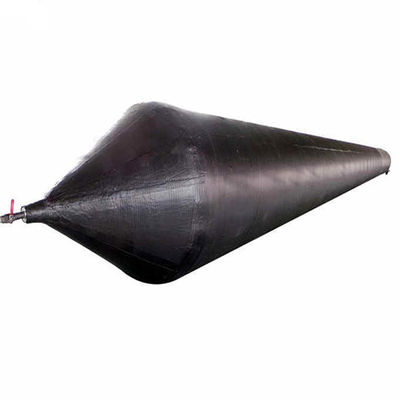
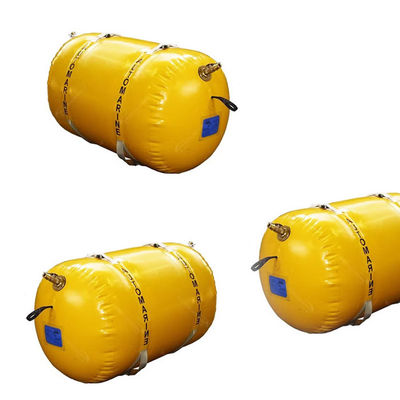
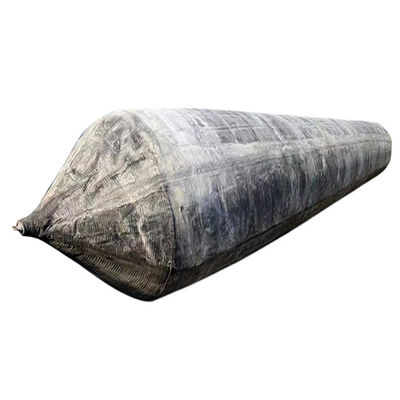
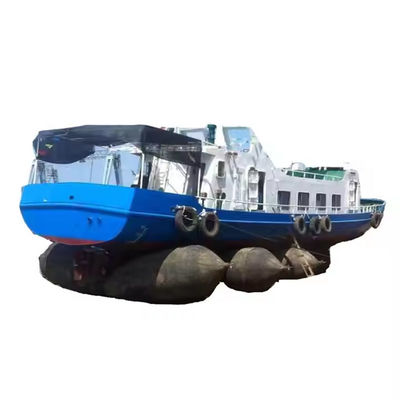
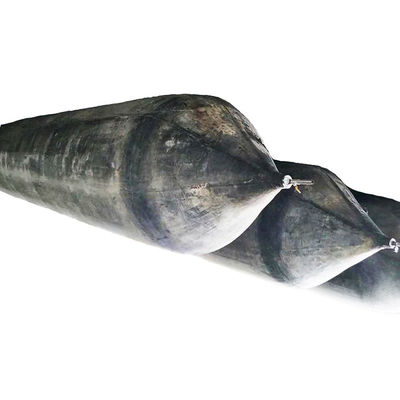
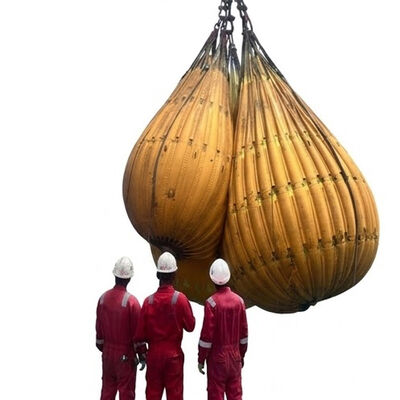
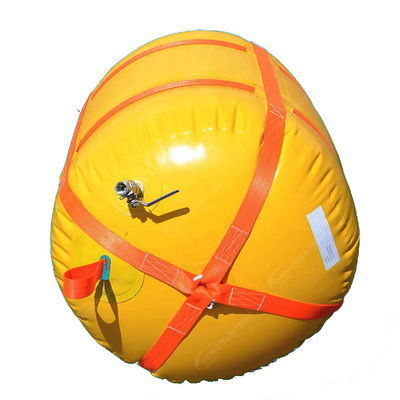
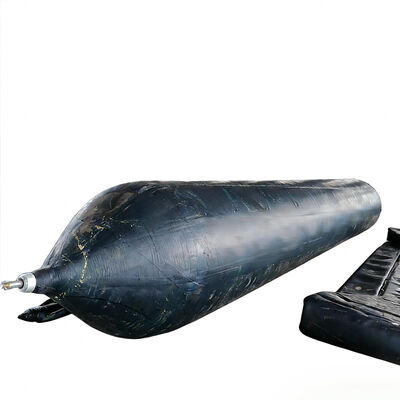
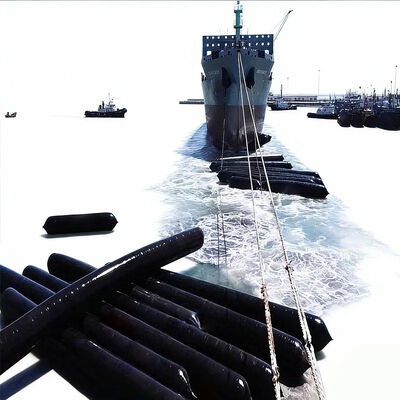
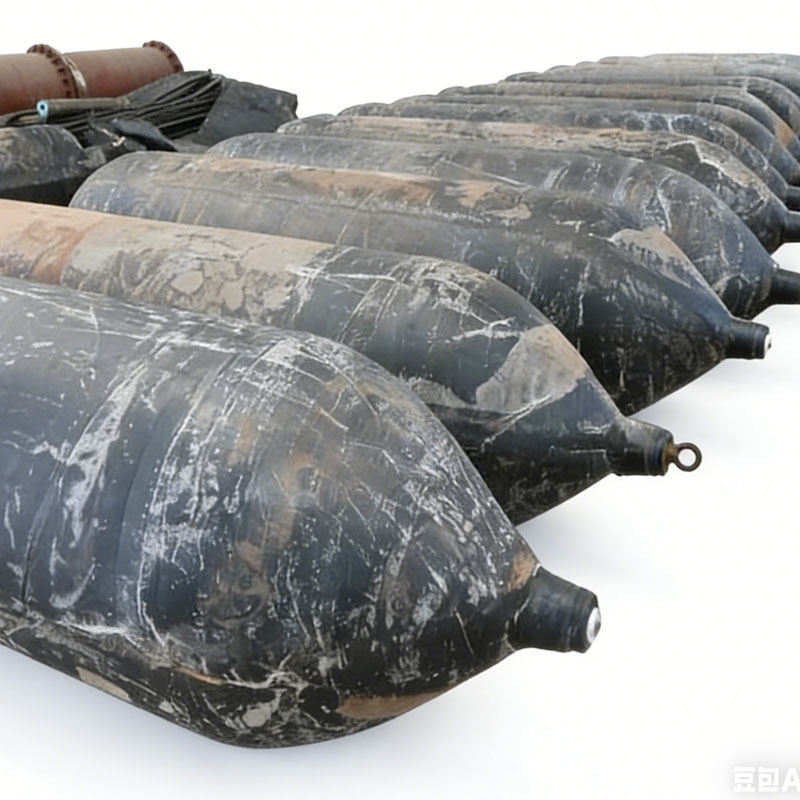
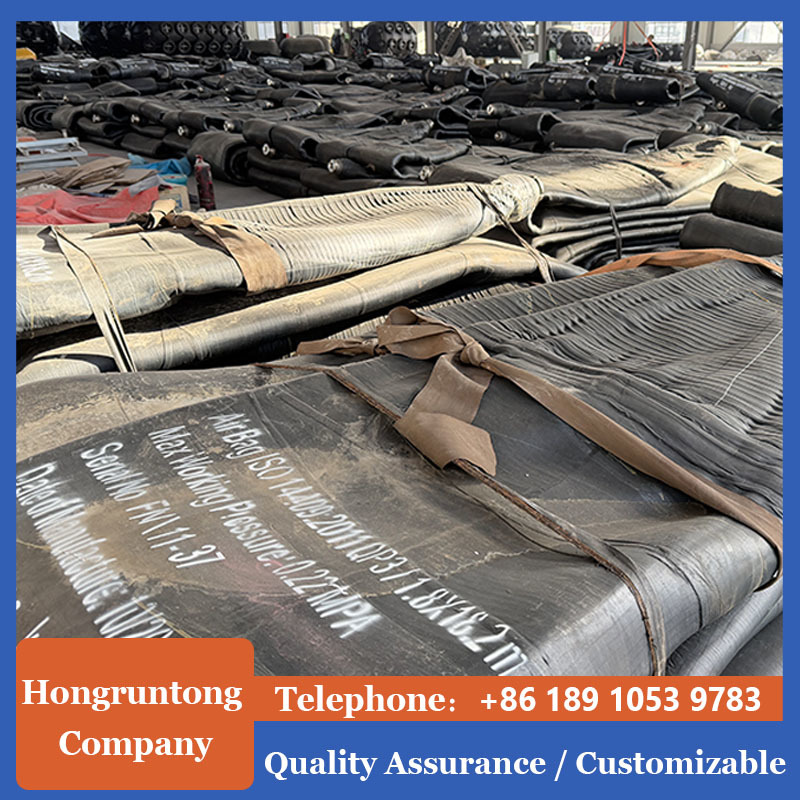
Airbag launching technology is an advanced and flexible ship-to-water transfer method that uses high-strength, pneumatic marine airbags to support a hull and convert stored elastic energy into controlled rolling motion during launch. Compared with fixed-track slipways, airbags minimize infrastructure requirements, reduce engineering downtime, and enable shipyards to operate in environments where traditional launching systems are impractical.
Airbag-based launching distributes hull loads dynamically, reducing localized stress peaks, preventing structural damage, and ensuring stable hydrodynamic transition when the ship enters water. Modern airbags are constructed with multi-layer synthetic-tire-cord reinforcements, abrasion-resistant rubber compounds, and optimized internal pressure systems that maintain uniform deformation, even under high load.
A representative engineering case involved the launching of a 9,600-ton multi-purpose cargo vessel at a mid-size shipyard in Southeast Asia. The site was constrained by shallow shore gradient, limited quay infrastructure, and a compact construction footprint.
The shipyard initially planned to invest in a fixed rail-based slipway. However, cost analysis showed that the required foundation reinforcement, track installation, and long-term maintenance would exceed budget and extend the project timeline by more than a year. The engineering team evaluated marine airbags as an alternative solution to meet the shipowner's delivery schedule.
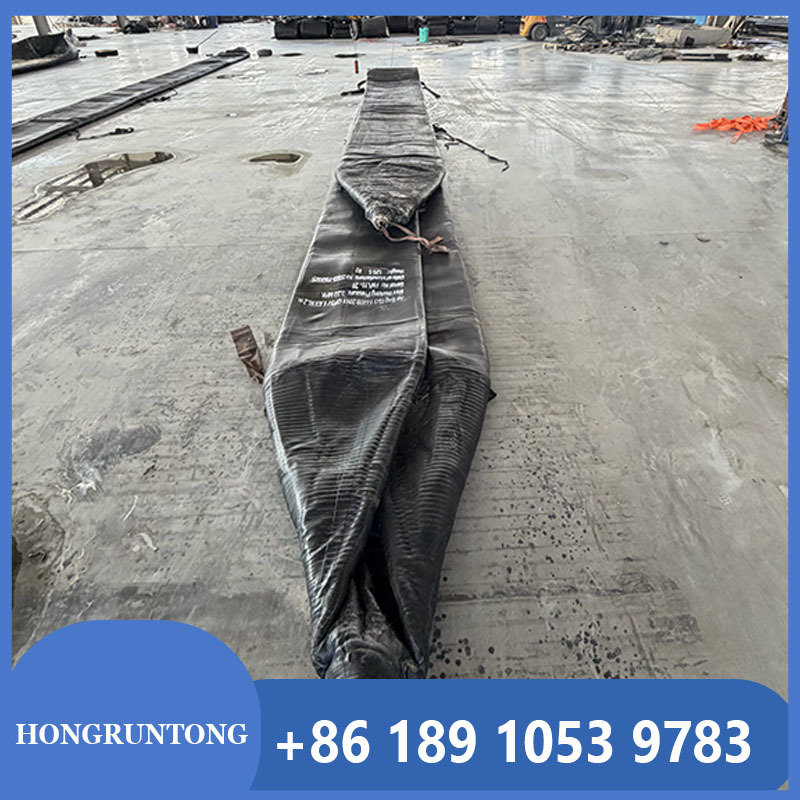
A launching system was designed using 28 airbags, each 1.8 m in diameter and 18 m in length, arranged at calibrated spacing beneath the hull blocks. Finite-element load simulations were conducted to determine rolling friction coefficients and hull-support distribution.
Throughout the launch, real-time monitoring equipment measured hull displacement, airbag pressure changes, and ground-reaction variation to ensure the vessel maintained correct alignment. Post-launch inspection revealed no hull deformation, coating abrasion, or structural stress anomalies. The entire launching procedure took less than three hours, enabling the yard to deliver the vessel ahead of schedule with a 38% reduction in total launch costs.
| Item | Description |
|---|---|
| Place of Origin | China |
| Brand Name | Hongruntong Marine |
| Material | Industrial Grade Natural Rubber |
| Diameter | 0.5m-3.0m, or as Request |
| Length | 1.0m-28.0m, or as Request |
| Working Pressure | 0.05-0.25 Mpa |
| Technics | High Pressure, Overall Winding, Explosion-Proof |
| Use | Ship Launching and Docking |
| Thickness | 5-13 ply |
| Standard | Conducted by ISO14409 and GB/T1590-2006 system. |
| Accessories | Q355/SS304/SS316, Pressure Gauge, Tee, Plug, Switch, Inflation Tube |
| Packaging | Inner-Plastic Bag; Outer-Standard Wooden Pallets. |
| Certificates | ABS, BV, KR, LR, GL, NK, RINA, DNV, RMRS |
| MOQ | 1 |
| OEM | Welcome |
| Diameter | Working Pressure | Working Height | Bearing Capacity KN/m | Bearing Capacity Ton/m |
|---|---|---|---|---|
| D=1.0m | 0.14Mpa | 0.6m | 87.96 | 8.98 |
| 0.5m | 109.96 | 11.22 | ||
| 0.4m | 131.95 | 13.46 | ||
| D=1.2m | 0.12Mpa | 0.7m | 94.25 | 9.62 |
| 0.6m | 113.10 | 11.54 | ||
| 0.5m | 131.95 | 13.46 | ||
| 0.4m | 150.80 | 15.39 | ||
| D=1.5m | 0.10Mpa | 0.9m | 94.25 | 9.62 |
| 0.8m | 109.96 | 11.22 | ||
| 0.7m | 125.66 | 12.82 | ||
| 0.6m | 141.37 | 14.43 | ||
| 0.5m | 157.08 | 16.03 | ||
| D=1.8m | 0.09Mpa | 1.1m | 98.96 | 10.10 |
| 1.0m | 113.10 | 11.54 | ||
| 0.9m | 127.33 | 12.98 | ||
| 0.8m | 141.37 | 14.43 | ||
| 0.7m | 155.51 | 15.87 | ||
| 0.6m | 169.65 | 17.31 | ||
| D=2.0m | 0.08Mpa | 1.2m | 100.53 | 10.26 |
| 1.1m | 113.10 | 11.54 | ||
| 1.0m | 125.66 | 12.82 | ||
| 0.9m | 138.23 | 14.11 | ||
| 0.8m | 150.80 | 15.39 | ||
| 0.7m | 163.36 | 16.67 | ||
| 0.6m | 175.93 | 17.95 |