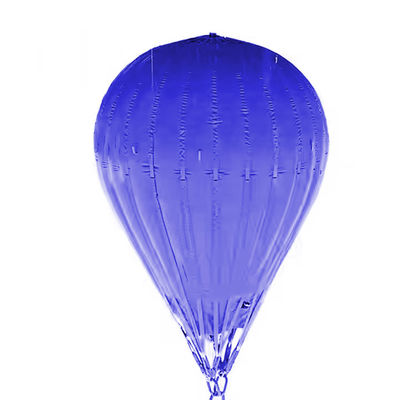
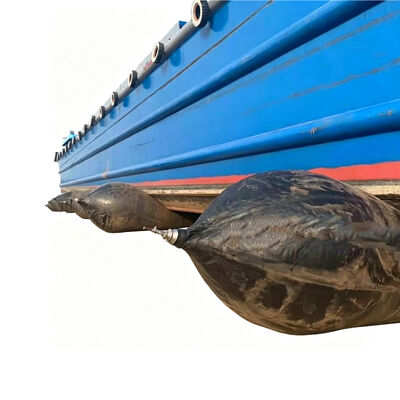
Ship Launching Airbags High Bearing Capacity Wear Resistant Rubber Easy Installation
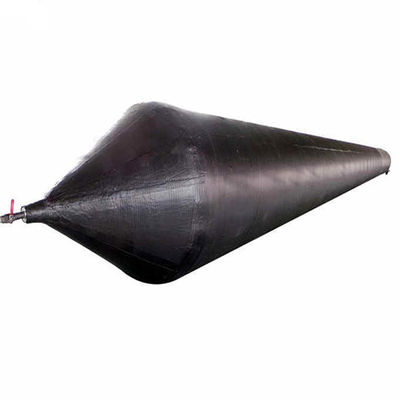
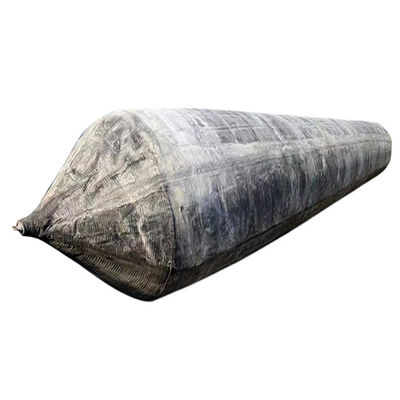
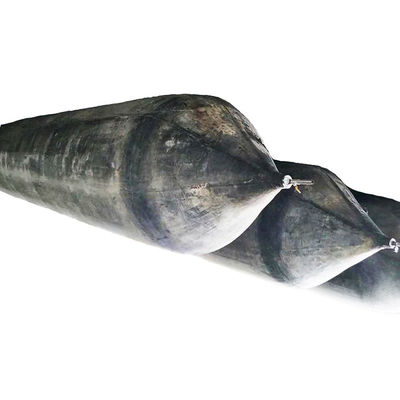
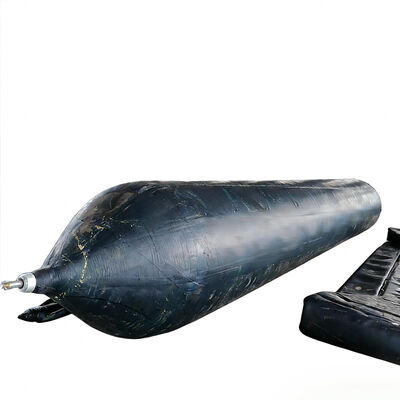
Inflatable Marine Airbags are flexible, high-strength marine handling products engineered for vessel launching, hauling, beaching, repositioning, and temporary support operations in shipyards, coastal repair facilities, marine construction yards, and other vessel-handling environments. The system uses compressed air as the working medium and combines a cylindrical flexible body with reinforced rubber construction to create a temporary load-bearing interface between the vessel hull and the prepared supporting surface.
Product Overview
The main body is manufactured from multiple integrated layers, normally consisting of an inner airtight rubber layer, several high-strength synthetic tire-cord reinforcement layers, and an abrasion-resistant outer rubber layer. The inner rubber layer maintains the internal air pressure, while the reinforcement layers provide tensile strength and control dimensional deformation under load. The external rubber layer protects the structural reinforcement against abrasion, impact, moisture, weather exposure, and contact with the prepared ground.
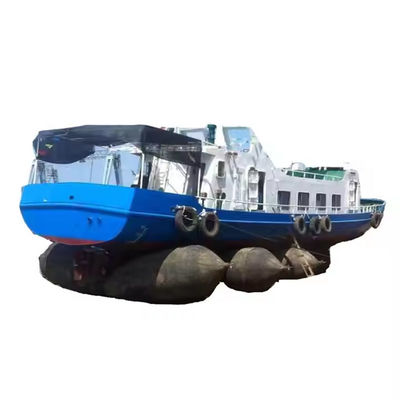
The operating principle is based on controlled internal pressure and distributed contact loading. After the airbag is positioned beneath the vessel and inflated to the specified working condition, the cylindrical body deforms under the vessel load and forms a contact area with the hull and supporting surface. The load is transferred through this contact zone rather than concentrated at a small number of rigid support points.
Case Study: 3,200-Ton General Cargo Vessel Launching
A medium-sized shipbuilding company in Southeast Asia successfully launched a 3,200-ton general cargo vessel using inflatable marine airbags. The shipyard's existing infrastructure lacked a permanent slipway system designed for vessels of this displacement, making the airbag system an ideal solution.
Before installation, the shipyard prepared the launching surface by removing loose stones, welding debris, metal fragments, and other objects capable of damaging the external rubber layer. Based on the vessel's calculated launching weight, hull dimensions, and operating conditions, the required airbag diameter, effective length, quantity, and longitudinal spacing were established.
The vessel was moved using controlled pulling equipment, with the launching team monitoring airbag alignment, contact condition, vessel movement, and operating pressure throughout the process. After the vessel achieved sufficient water support, the airbags were released, deflated, recovered, and inspected, remaining suitable for subsequent operations.

Technical Specifications
| Item |
Description |
| Product Name |
Inflatable Marine Airbags |
| Material |
100% Grade A Natural Rubber |
| Type |
Inflatable, Lifting, Roller, Launching |
| Diameter |
0.5m-3.0m, or As Request |
| Length |
1.0m-28.0m, or As Request |
| Working Pressure |
0.05-0.25 mpa |
| Standard |
Conducted by ISO14409 and GB/T1590-2006 system |
| Accessories |
Q355/SS304/SS316, Pressure Gauge, Tee, Plug, Switch, Inflation Tube |
| Packaging |
Inner-Plastic Bag; Outer -Standard Wooden Pallets |
| Color |
Black |
| Certificates |
ABS, BV, KR, LR, GL, NK, RINA, DNV, RMRS |
| Applications |
Ship launching and docking, Marine salvaging, Dry-docking, Bridge construction, Heavy machinery transportation |
| OEM |
Welcome |
Load Capacity Specifications
| Diameter |
Working Pressure |
Working Height |
Bearing Capacity KN/m |
Bearing Capacity Ton/m |
| D=1.0m |
0.14Mpa |
0.6m |
87.96 |
8.98 |
| 0.5m |
109.96 |
11.22 |
| 0.4m |
131.95 |
13.46 |
| D=1.2m |
0.12Mpa |
0.7m |
94.25 |
9.62 |
| 0.6m |
113.10 |
11.54 |
| 0.5m |
131.95 |
13.46 |
| 0.4m |
150.80 |
15.39 |
| * Other sizes can be produced following client's requirements |
Key Features
High Strength Multi Layer Reinforced Construction
The structural configuration features a composite arrangement of rubber and synthetic tire-cord reinforcement. The inner rubber layer provides airtight pressure retention, while multiple reinforcement layers control expansion and deformation. The outer rubber layer offers mechanical protection against the working environment.
Pressure-Dependent Load Distribution
Working behavior is directly related to internal pressure, vessel load, effective contact length, and contact geometry. The flexible airbag develops a changing contact area according to applied load and internal pressure, accommodating variations in hull bottom and changes in vessel support conditions.
Abrasion-Resistant Outer Rubber and Environmental Adaptability
The outer rubber layer provides primary protection against concrete, compacted soil, marine moisture, saltwater, and mechanical contact. It features suitable resistance to abrasion, tearing, weathering, and repeated deformation, with consistent rubber formulation and controlled vulcanization contributing to stable mechanical performance.
Precision-Engineered End Fittings and Pressure Management
End fittings form the critical interface between the airbag body and external inflation system, providing connection points for compressed air, pressure measurement, and controlled deflation. Proper fitting installation and inspection contribute directly to operational stability and pressure-retention reliability.
Applications
- Shipbuilding and New Vessel Launching: Positioned beneath steel hulls for vessels including cargo vessels, fishing vessels, workboats, and barges
- Ship Repair, Hauling, and Beaching: Used when vessels must be transferred from water to land for hull inspection, maintenance, and repair operations
- Marine Construction and Temporary Vessel Relocation: Provides temporary rolling support for barges, workboats, and floating structures where permanent infrastructure is unavailable
Why Choose Hongruntong Marine
- More Than 30 Years of Marine Manufacturing Experience: Long-term manufacturing background provides practical knowledge of rubber-based marine equipment and reinforcement structures
- Engineering-Based Product Selection and Customization: Evaluation of project information including vessel displacement, hull dimensions, support length, and operating conditions
- Controlled Materials and Manufacturing Processes: Uses reinforced rubber construction designed for pressure retention, mechanical loading, and environmental exposure
- Technical Support, Documentation, and Project Coordination: Comprehensive support from initial specification through production and delivery
Frequently Asked Questions
What is the typical construction of an Inflatable Marine Airbag?
A marine airbag normally consists of an inner airtight rubber layer, multiple synthetic tire-cord reinforcement layers, and an outer rubber layer. The layers are integrated through controlled vulcanization to form a reinforced pressure-bearing structure.
How should the required airbag quantity be determined for a vessel?
Quantity should be established from the vessel's actual launching or hauling weight, airbag bearing capacity, effective length, working pressure, hull geometry, support arrangement, and applicable safety requirements. Vessel length alone is not sufficient for determining the quantity.
What inspection is required before using a marine airbag?
The external rubber surface should be checked for cuts, punctures, deep abrasion, exposed reinforcement, abnormal deformation, and other visible defects. Inflation fittings, valves, gauges, and connections should also be checked, followed by the applicable pressure and leakage testing procedure.
Can Inflatable Marine Airbags be customized for different shipyard projects?
Yes. Diameter, effective length, reinforcement configuration, fittings, and other technical parameters can be specified according to project requirements. The final configuration should be confirmed using vessel and operating data before manufacturing.
How should marine airbags be transported and stored after use?
After deflation, the airbags should be cleaned and inspected before storage. They should be protected from sharp objects, excessive heat, prolonged direct sunlight, oil, chemicals, and unnecessary mechanical deformation. During transportation, the folded or rolled airbag should be secured to prevent damage.


 Your message must be between 20-3,000 characters!